Friday, June 11, 2010

Do the can-can

It's time to wrap up the Week of the Chicken by doing the can-can!  I'm excited to show you how to can, as it's the reason I started this blog in the first place.  I do have some apprehension about pressure-canning being my first thing out of the gate.

I bought my pressure canner on ebay.  The first time I used it I was scared to death it would explode so I stayed the heck away from it.  I was also scared to death that we'd get botulism.  Turns out that I was canning at 15psi instead of the recommended 10psi, which explains why my first batch of home-canned asparagus was aspara-mush.

CYA STUFF
Before I go any farther, I want to point you to an excellent canning and preserving resource, the National Center for Home Food Preservation.  When in doubt, refer to that website and it'll tell you how to can specific things (like pumpkin cubes) and when there are no safe tested methods (like pumpkin puree).  I refer to the site all the time because you never know when a method has been updated.

I used to be an active member of a forum where people would sometimes promote unsafe canning methods on the basis of "my grandmother did it, my mom did it, and I do it and nobody has ever gotten sick".  I'd get seriously pissed off and tell them (and any new canners who were reading) that they were welcome to serve that to their families, but my family and friends would only get food that had been canned according to the HFP guidelines.  That means that only things that are high acid - pickles and fruits - get canned in a boiling water bath and everything else got pressure canned according scientifically proven methods.

On that note, it's my promise to you that I follow the HFP guidelines for safe home canning methods.  If you spot something in a picture or in my directions that's incorrect, let me know ASAP and I'll correct it.   I want this to be a safe resource for you.

OK, let's do this thing!

Thursday, June 10, 2010

Take stock

The grand finale of roasting a chicken is the stock. 

Why make your own stock?

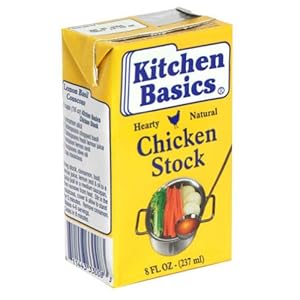
This stock costs $12.64 for 15 8-ounce cartons on http://www.amazon.com/.  That's 10.5 cents/ounce. 

My stock pot makes about 7 quarts (about 225 ounces).  Since the chicken is already paid for and the stock seasonings are cheap or free, I make my own stock for less than $5.  Even if it cost $10 to make my own stock (which is doesn't), that's still 4 cents/ounce and still cheaper.  I pressure can my own stock, making it shelf-stable for up to a year.  The final advantage is that you know exactly what's in your stock when you make it at home.

Chicken Stock

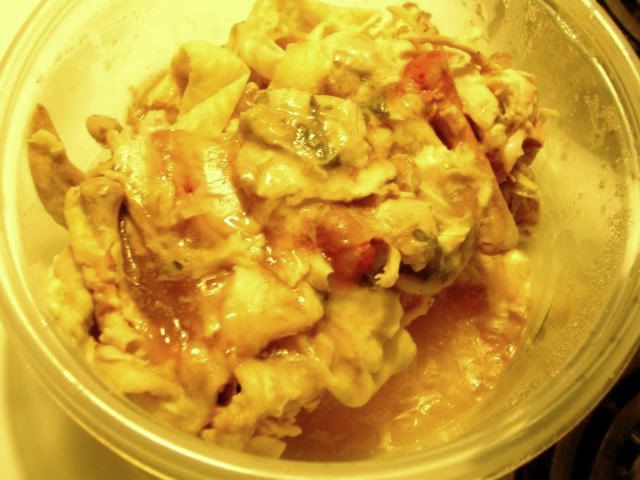
Here's all the chicken goop left over from my roasted chicken.

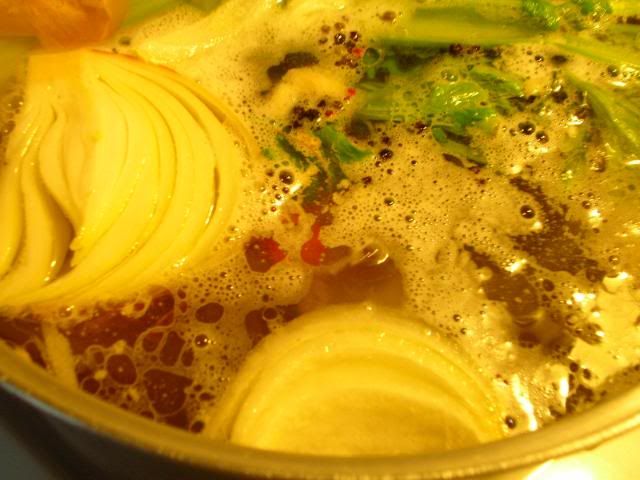
I dumped the chicken goop into my biggest stock pot, which is over a foot tall and about as wide.  Clean & break up some celery stalks, 2 carrots, and wedges of an onion.  Don't even bother taking the papery skin off the onion.  Dump in about a tablespoon of salt, a handful of peppercorns, and a few springs of thyme.  Throw in some garlic cloves if you feel like it.

I don't bother with a bouquet garni because I strain my broth at the end.  If you do make a bouquet garni, grab the biggest tea ball possible and use that instead of trying to tie up a bunch of loose herbs.  I swear it's easier!

Bring the water to a boil then turn it down and let it simmer for a couple of hours.  If foam or scum develops on the surface, grab a slotted spoon and skim off the foam every so often.  Running the spoon through a bowl of water will help get the scum off and make this task easier.

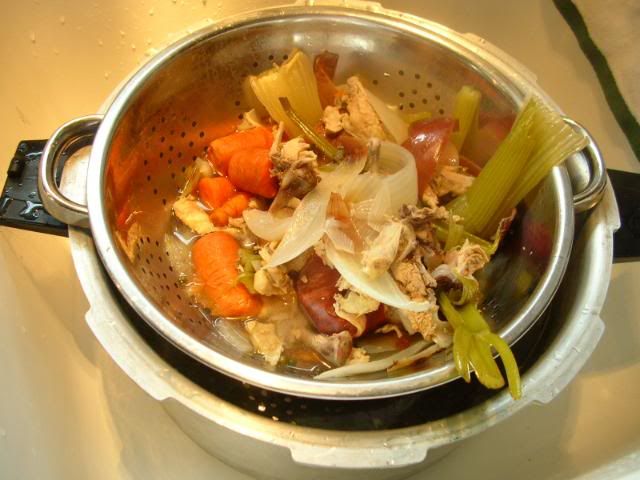
After a couple of hours, put another massive pot in the sink and put your colander in it.  A friend told me a story about his mother, who had labored over a turkey stock all day only to strain it through the colander straight into the sink.  To quote my brother, "I would kick my own ass if I did that".

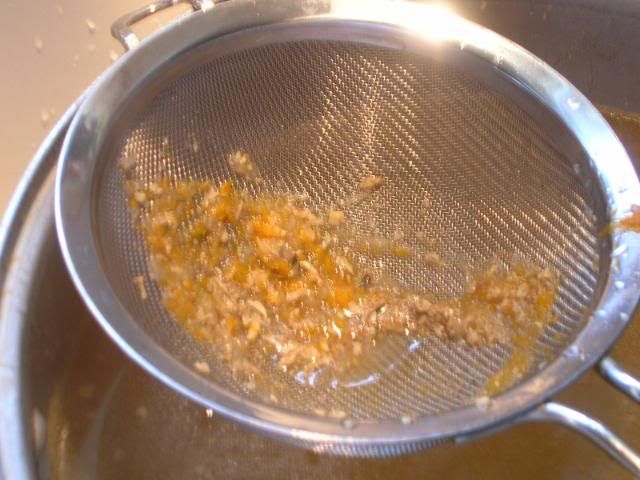
Rinse the first pot, grab the finest strainer you own, and strain the broth again. 

 
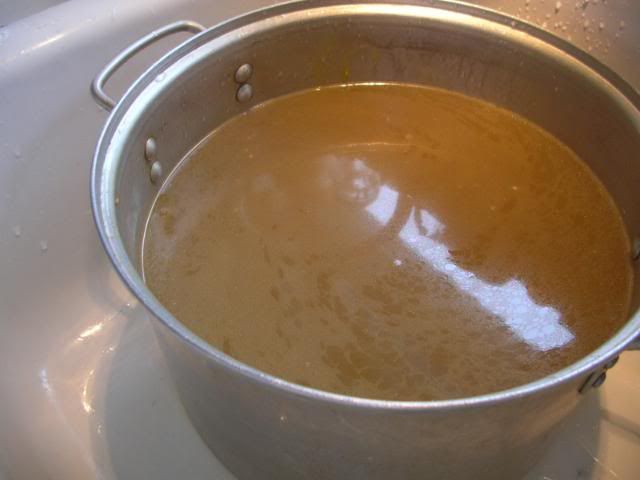
Now you'll have a massive pot of gorgeous, homemade, and yummilicious chicken stock.  Let it cool on the counter (don't put it in the fridge hot or it'll raise the temp of your fridge and imperil your other perishables).  If you want to cool it rapidly, use an ice water bath or put it in lasagna pans to increase its surface area.  If you cool it down and refridgerate it overnight you can skim the hardened fat off before freezing or canning the stock.

I like these containers a lot for soups & liquids because the lid is very secure.

If you have a pressure canner/cooker, you should can your own stock.  I'll show you how tomorrow.

Wednesday, June 9, 2010

It's a Gouda thing

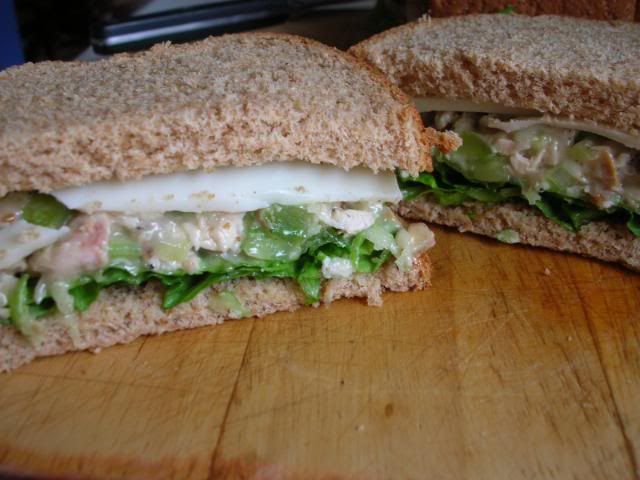
For yesterday's post I roasted the chicken and saved all the leftover bits, for my next trick is to make a chicken salad sandwich with Gouda.  I remembered seeing an Ina Garten show once with a similar recipe, so I pretty much winged this one from memory.

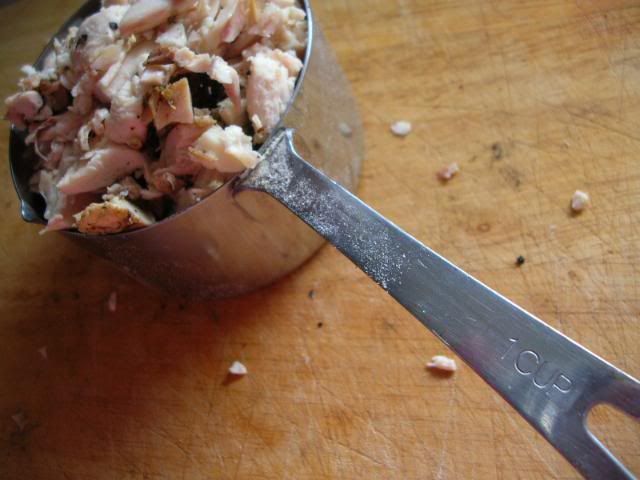
Here's about a cup of chicken meat.  It's amazing how much meat there is on a roasted chicken, so don't throw it out after you've carved off the main bits.  Yumminess awaits.


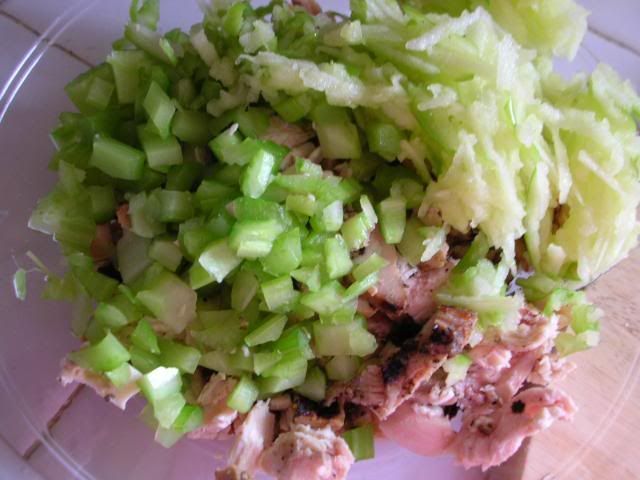
I had about a cup of leftover chicken bits, which I mixed with diced celery and shredded Granny Smith apple.

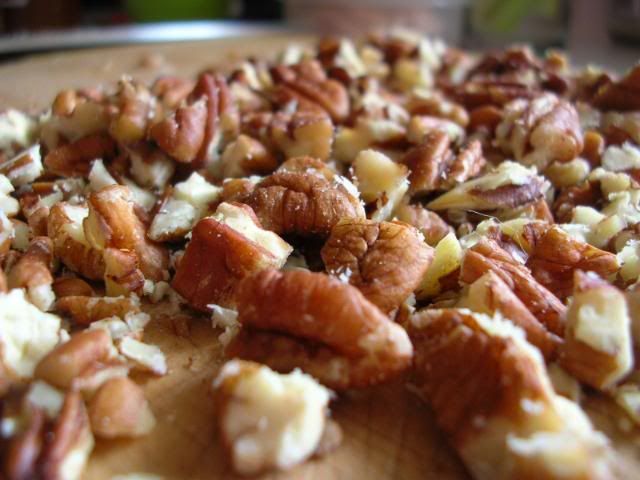
Mix in some mayo, a titch of dijon mustard, maybe some Wostershire sauce, and some chopped pecans.  This recipe really made me wish that we didn't use crappy lowfat mayo.

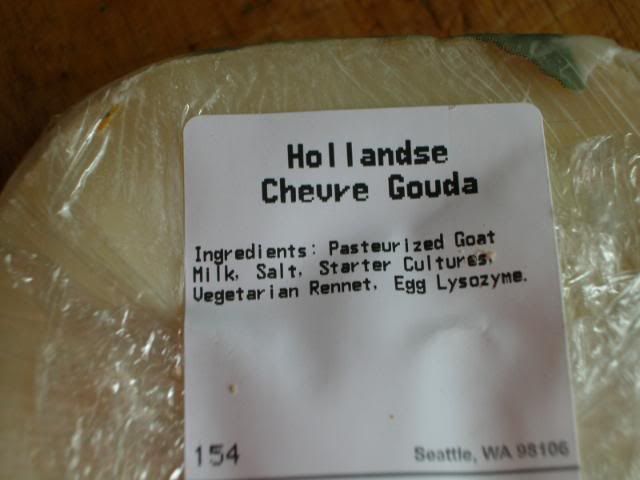
I had this fabulous goat cheese Gouda tucked away in the fridge. 
"You had me at chevre."

I love chevre cheese.

There was a teensy bit left over after making 2 sandwiches.  The next day I made open-faced sandwiches on English muffins and melted the Gouda.  Yummmmm.

Tomorrow: what to do with that chicken carcass that's in the fridge.

Tuesday, June 8, 2010

Roasted chicken with garlic

I promised this would be (insert announcer voice): The Week of the Chicken!  These posts are what I had in mind when I decided to do a theme week but I pushed them to the end of the week because of the coop redecorate & the neighbors' new chicks.

When I buy a whole fryer I use the entire thing.  I roast it for the first ~4 meals, pick the meat off for another 2-3 meals, then make stock with everything that's left.  I'm going to show you over the next few days how to get every penny's worth out of a whole chicken.  Those organic, free-range, happy chickens are pricey.

Let's get cooking!

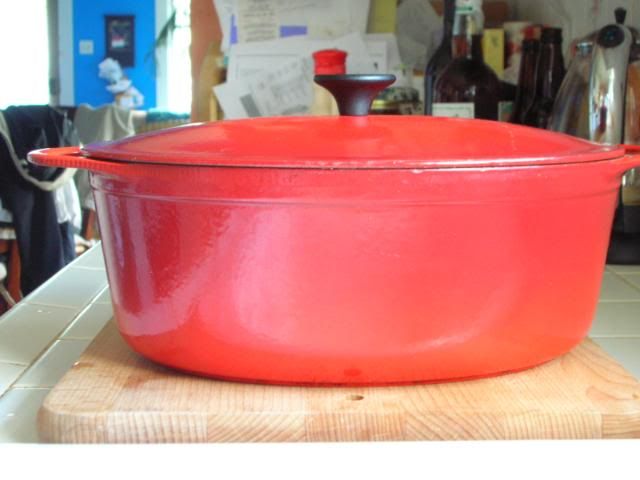
I bought this in France in 1998 and lugged it back in my luggage, which a friend picked up and asked if I was carrying bricks.  "Nope: cast iron," I cheerfully replied!  It cost me 200 francs ($40).  Best. Purchase. Ever.


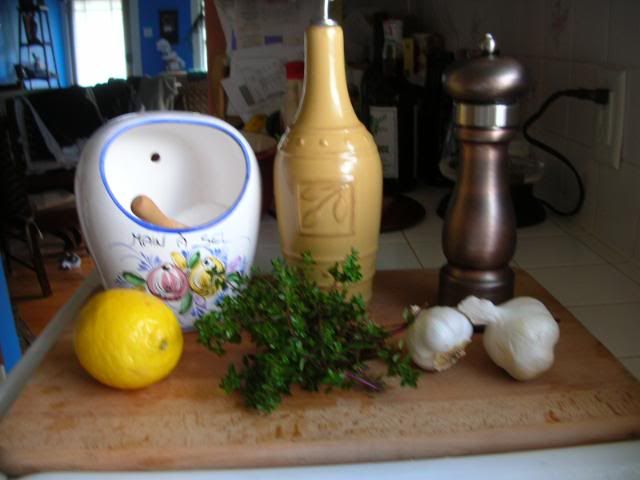
Assemble your gear.  I've got 2 heads of garlic, salt, pepper, olive oil, thyme, and a lemon.  You'll also want some root vegetables, such as carrots, potatoes, or parsnips.  I used 4 potatoes.

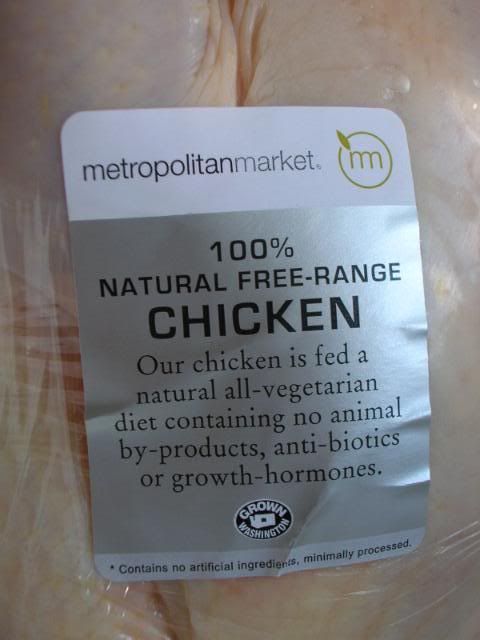
Met Mart had a sale on whole fryers.  I think this was about $5, which is about half price.

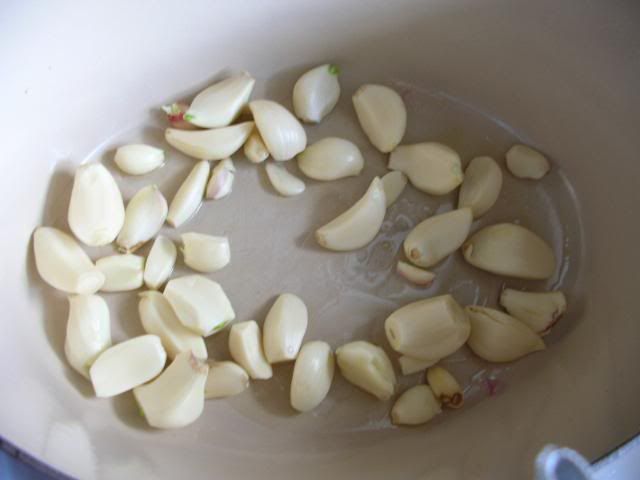
I loosely based my recipe on Alton Brown's.  I thought that browning the chicken was too fussy.  Screw that.  Just peel the 2 heads of garlic & throw them into the pan.

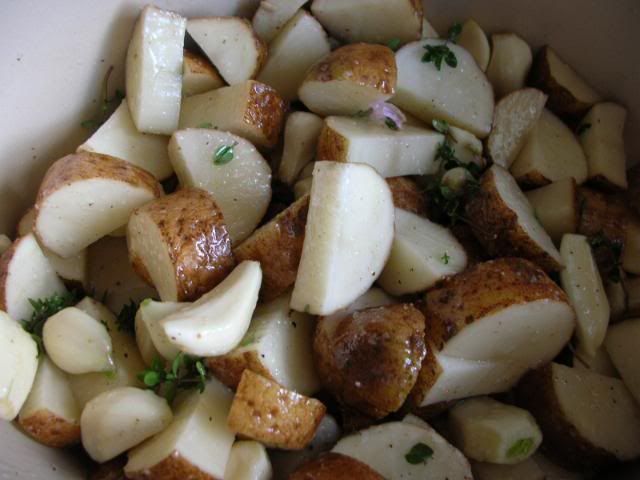
Cut up 4 potatoes and throw those into the pot.  Add a few sprigs of thyme, some salt, pepper, and olive oil.  Toss it with your hands and you're done!

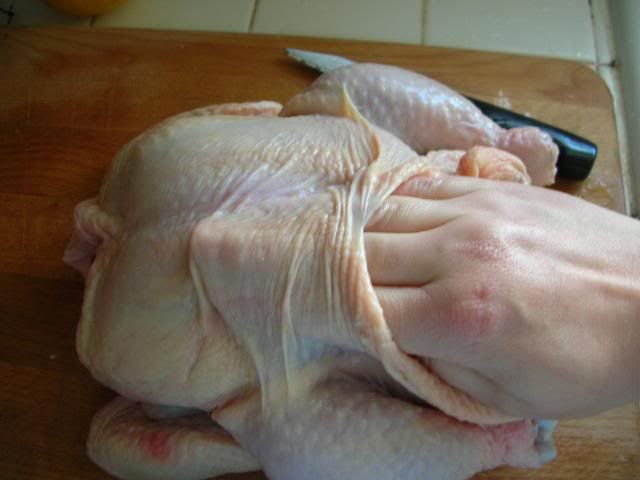
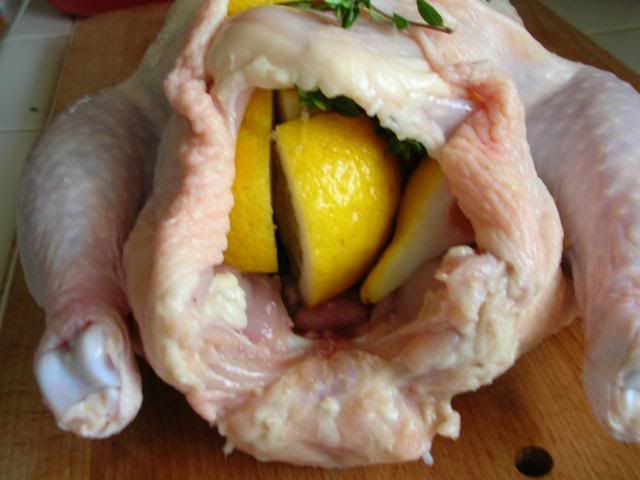
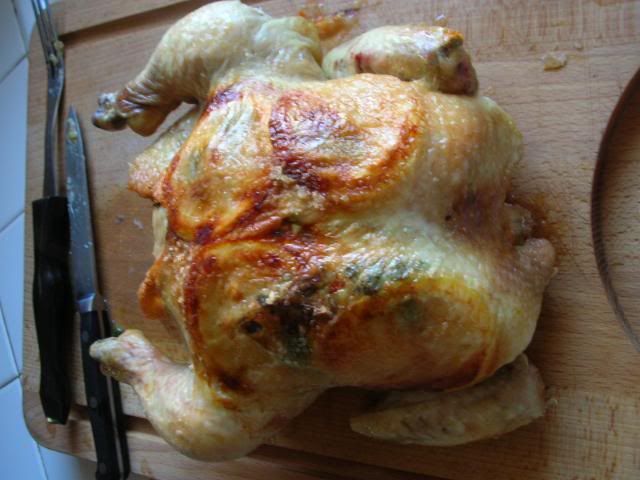
Buy the chicken a drink because you're about to get freaky.  Separate the skin from the flesh very carefully.  Put some thin lemon slices between the skin and the flesh.  Cut up the leftover lemon into wedges and stuff it into the business end of the chicken.

You could also put some onion wedges in there if you were so inclined.

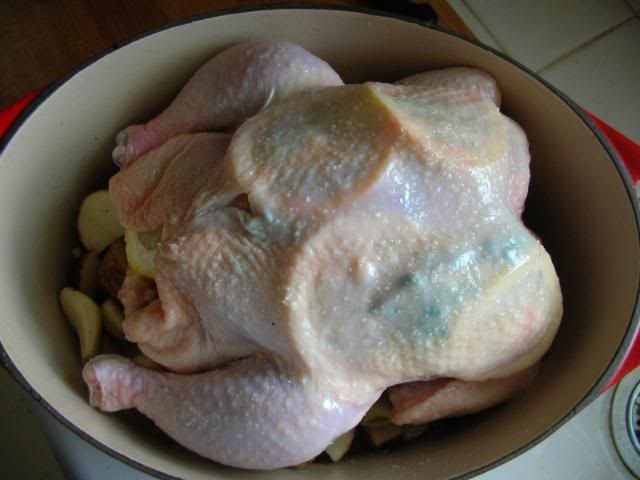
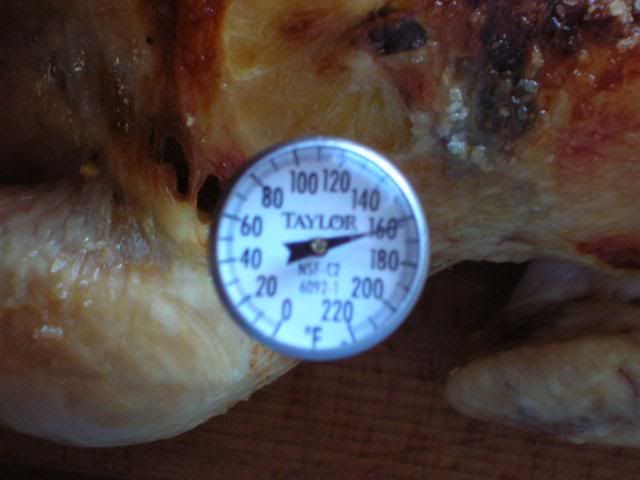
Put the chicken on top of the potato/garlic mixture, tuck the wings under the body, and bake at 375.  Check temp after 45 minutes.  Remove from the oven when the chicken temp reads 160-165F.


Rose wines are meant to be crisp/dry and served cold.  We're not talking about that syrup-y crap out of a box or jug, nor anything whose name rhymes with shoe-muck Shuck.  By rose I mean a dry, low-sugar wine like this one from Met Mart.  I love Met Mart's house wines.  I loved last year's "Red" so much that we bought a case! 
Don't turn your nose up at rose wines.  There are some fabulous ones out there that are perfect for summer dining.  I started drinking rose wines in France, where they're the go-to drink for picnics and alfresco meals. 

I've heard that white zinfandel is making a comeback as a real, palatable wine.  I can't bring myself to even consider it without thinking of the joke about personalities being matched to drink preferences:

Drink: White Zinfandel

Personality: Easy; thinks she is classy and sophisticated, actually, she has NO clue (probably a blonde).

Your Approach: Make her feel smarter than she is...this should be an easy target.

Anyway, enjoy some wine while the chicken rests for about 10 minutes. Make some salad or something.

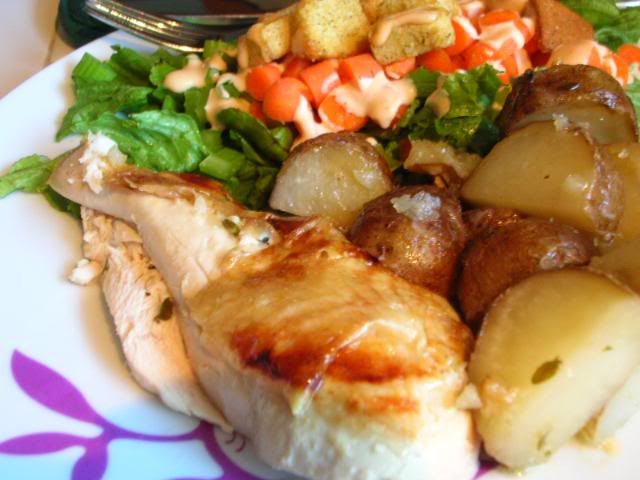
Serve the chicken with some potatoes, garlic, and a salad.  This serves 4-6, depending upon the size of your chicken.

After your meal is done, pick all remaining bits of meat off the carcass and put it into a container in the fridge.  Put all leftover bones, skin, and any juice from the cutting tray into a large bag or bowl and hang onto it.  I'll show you what to do with the leftovers in my next post.

Monday, June 7, 2010

Chick fix


Ours are not the only chickens in our neighborhood.  The family 2 doors down got 6 chicks a couple of months before we got ours in May 2008.  In retrospect I think that our getting chicks was a seminal moment in our friendship because it gave us a reason to visit each other regularly and to discover other commonalities. 

Kim stopped by to chat the other day and told me that she had agreed to let each of her 3 boys pick out a chick.  I think that Kim wanted more chicks so decided to "let" the boys get them.  Sneaky lady!

Sure enough the family drove up this Saturday afternoon with a massive box containing 3 delicate little babes.  After you've had full-grown hens for a while, you forget how dainty and small chicks are.  I think that hers are about a week old.  Chicks are only cute fluffy things for about 3 weeks total.  They grow and change right in front of your eyes.

The boys' cousin walked up with a mewling grey tabby in his arms.  He told me proudly that his aunt and uncle had adopted her.  She was so sweet and adorable, no wonder.  The dad rolled his eyes and told me it was a lost cause once his wife said it was OK with her but dad had the final say.  The 3 sons and their cousin dialed up the doleful eyes and begging... and well, you know the rest.
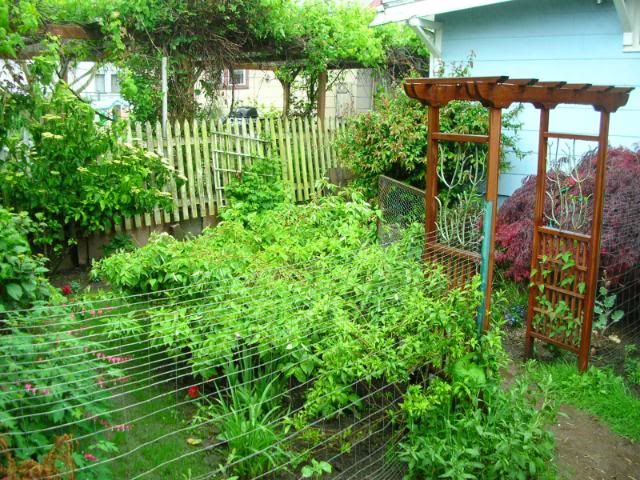
Their 3-year-old dubbed the new cat "Chicken" but Kim overruled him and is calling the kitty "Twinkle" after the book The Kitten Twins

Also new to their household are an Easter Egger and 2 australorps.  Apparently all of the chicks have some variation of "Elephant" in their name.  Leave it to a 3-year-old!

This is an Easter Egger.  She should lay eggs that will be blue or green.

They also got 2 australorps, one of my personal favorites.  They lay brown eggs.

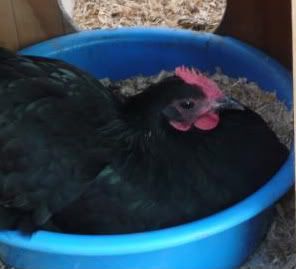
Australorps are wonderful hens.  I just love the look of their faces - I think it's the big dark eyes.  Their personalities are friendly and sweet, and they're very chatty birds.  They've got the softest feathers of the flock.


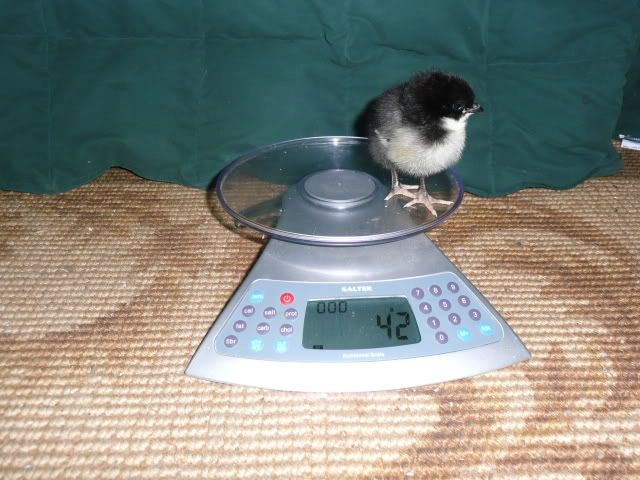
It's hard to believe that Croquette was this small just over a year ago:


Now that our neighbors have chicks I can live vicariously through them and hug them and kiss them and call them George.

Or should that be "Elephant George"?

Sunday, June 6, 2010

Week of the Chicken

Riding the tails of yesterday's post with random chicken egg facts, I've decided to make this "The Week of the Chicken".

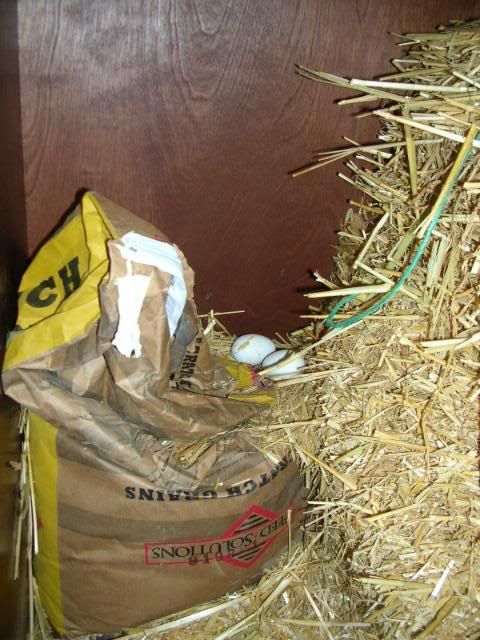
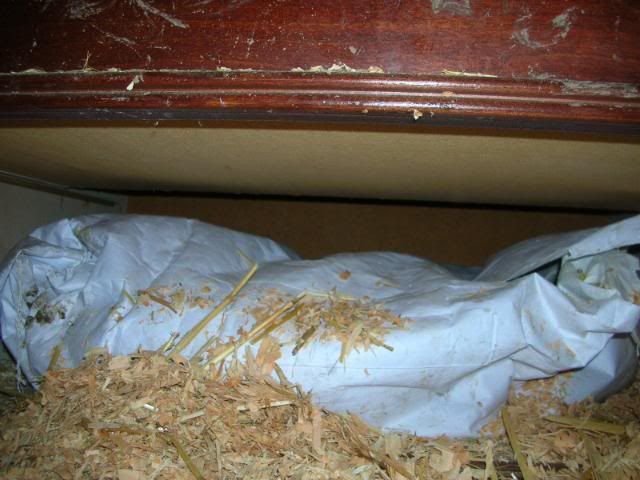
The new coop's layout isn't working as well as such a large space should be.  Animal and Miss Piggy have been getting picked on lately, and neither has many feathers left on her head.  Another problem was that some of the girls had created their own nesting area on a shelf.

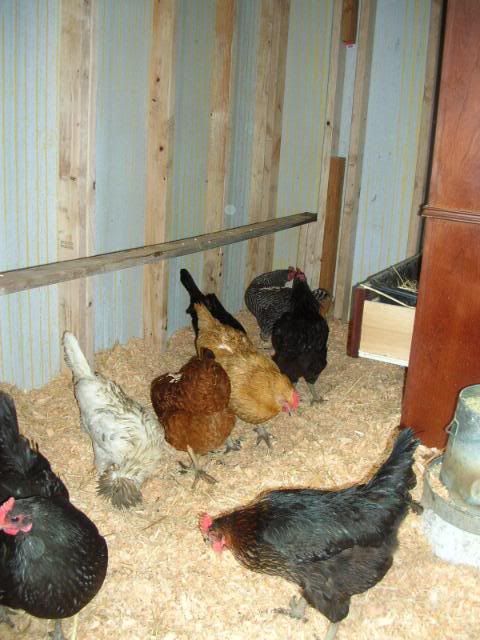
G-man and I decided to alleviate the pecking issue by switching the roosting bar from the 6-foot width of the coop to the 8-foot wall.  This meant the nesting boxes and storage cabinet had to move to the back of the coop. 

I'm glad I picked today to do this chore.  Yesterday was gorgeous in the PNW and I got lots of weeding done.  Today is a different story entirely: rain followed by sprinkles, interspersed with copious amounts of precipitation and liquid sunshine.  Then more rain.  I'm so sick of the rain.

Granted, my garden has gotten very green and is recovering nicely from the damage visited upon it over the winter by 9 hungry beaks and 18 scratching feet.  But I've planted parsnips thrice and none has come up.  so. frustrating.
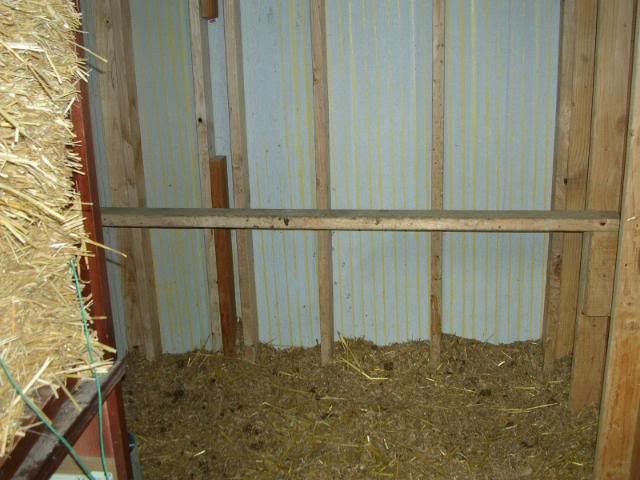
Anyway, before when you looked straight into the coop it was like this.  The roosting bar along the 6-foot back wall and nesting box/storage on the left.

There's Curry, earning her keep.

And now with it moved around, a new 8-foot roosting bar runs along the left wall and the nexting boxes/storage are in the rear right corner.  The only roosting bar I had available without a trip to the store was a 1x4.  I am willing to bet it is going to sag once the fat butts get on it.  Collectively they probably weigh 40-50 pounds.
The girls were eager to get out of the rain.

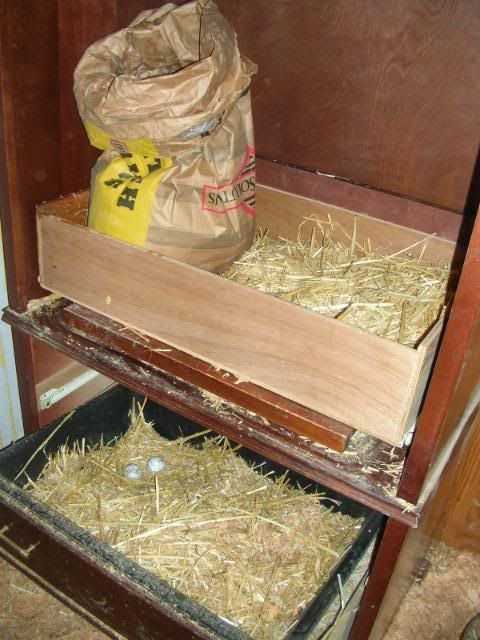
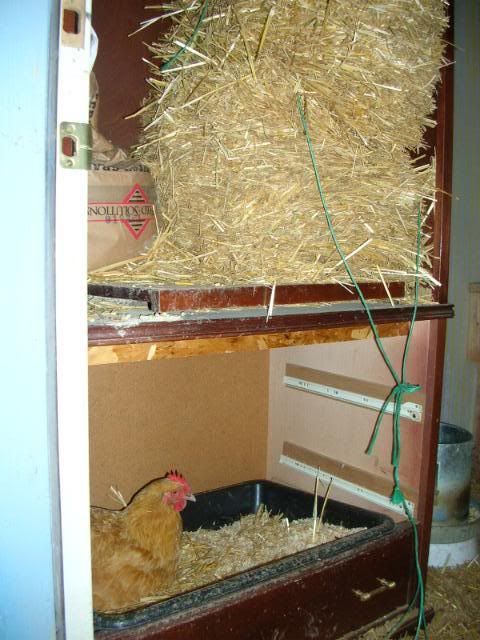
There's now a sanctioned 2nd nesting box.

I moved the bottom drawer up (this is an old entertainment center) to the middle slot and stashed the feed below to prevent the girls from laying under the drawer. 

UPDATE: I found the 3rd drawer in the garage and put it into the bottom slot with the feed in it.  While doing this I found an egg in the new nesting box and watched Nugget hop up into the bottom box while Croquette circled, looking for a nesting box.  These are pretty adaptable critters.

Saturday, June 5, 2010

Catching up, egg facts

The hubbie went on another business trip, this time to the TTXGP in Wisconsin.  It's the first electric motorcycle grand prix series and he's so excited he can barely contain himself.  He'll get home on Monday night, then turn around and leave Tuesday morning for Southern California to work on an electric motorcycle ridden by Chip Yates.  He met Chip on his recent trip to Northern CA a few weeks ago.  Suffice it to say, this traveling thing has paid off.

I have to admit to feeling like a poser writing about what G-man does.  He spouts off technical stuff about and names from the electric vehicle world all the time and I have no idea what most of it means.  I don't know the difference between a volt and a watt.  What I can say with confidence, though, is that I'm so proud of him.  I've known him for nearly 7 years, the first 5 of which he floundered professionaly, going from job to job and sometimes being in school.  He worked in about 5 jobs, none of which he remotely cared about longterm.  Seeing him pursue a career with a singular focus, drive, and excitement is inspiring.

With G-man prepping for an extended time away from home, I've been pulled away from the blog for a few days.  But don't worry.  I've been composing posts for you in my head and taking pictures this entire time.  I've got plans for:
  • Several posts on how to get every penny's worth from a whole roasted chicken
  • A series on honey: I've developing an obsession.  If you follow my facebook feed, you'll know I recently bought 6 lbs from a guy in a parking lot.  "Hey buddy.  You got da stuff?"
  • Some posts on "exotic" greens available now at the farmers markets, and what to do with them
  • Updates on the garden.  It's been raining in the PNW for weeks and weeks.  There's much to do.
I'll leave you with thoughts on commercially produced eggs.  People are surprised by some of the "weird" eggs our chickens lay: eggs with no yolks, odd shapes, eggs with no shell, teensy eggs, huge eggs, etc.  The reality is that these things are normal and perfectly uniform white eggs are the abnormality.

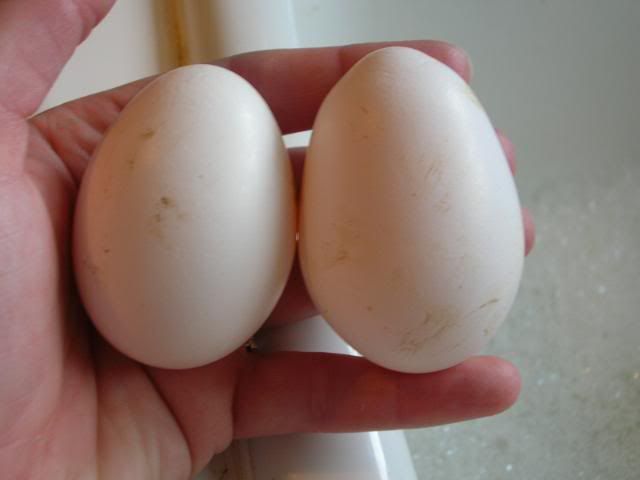
Check out these bad boys we got recently:

These were both laid by our polish crested hens, which are bantam (lightweight) breeds.  These hens weigh about 60% of what the production hens weigh.  They are what every girl wants to be: thin and fine-boned.  They're also completely neurotic but that's a whole other issue.

Polish are not supposed to be good laying hens but my girls have been the most reliable ones lately.  Not are they laying daily but their eggs are the same size as those of the hens that are much larger and eat much more.  They make a good case for a polish- or bantam-only flock.

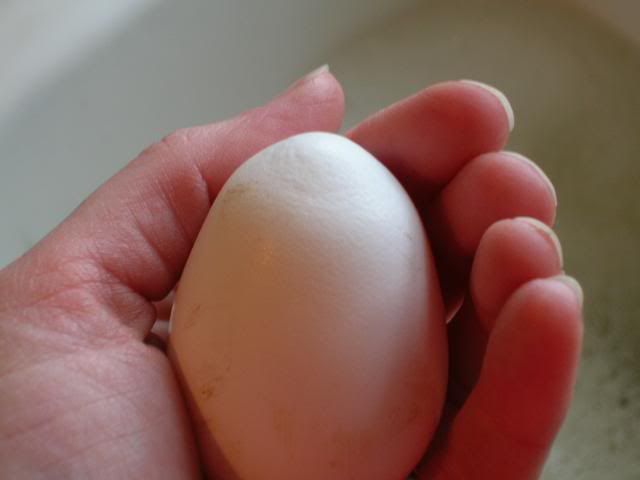
This one was pointy and ENORMOUS:


Some egg facts:
  • Did you know that the rounded end of an egg comes out first?
  • Pinhead-sized dark spots inside an egg are caused by a capillary in the ovary bursting during the egg production.  They are harmless and will hurt neither the hen nor your food.
  • A hen's eggs get bigger & lighter in color over time.  She'll stop laying during a molt, after which her eggs will again be darker.
  • The only difference between a white and brown (and pink, green, or blue, for that matter) egg is the outside pigmentation.
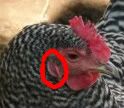
  • Egg color is determined by the hen's breed, not the feather color, and is correlated to her earlobe color.  In general, the darker the skin, the darker the egg.  Our polish have blue earlobes.  Here's Dozer, modeling her earlobe for you:

Check out this one's earlobes (not my bird/pic).  This is a silkie, which lays white eggs.  I believe this is a rooster.


If you have a strong stomach, check out these weird eggs.  Warning: some of the pics are pretty gross.