I used up the last of our girls' eggs this morning. We're officially relegated to store-bought eggs until the ladies kick into gear again.
Last year we got no eggs from December until sometime in April. This year some of the girls starting molting in August, which was very early for them. I took it as a signal that our La Nina winter was to be very cold but thus far it's been fairly mild. I suppose we still have several months to go.
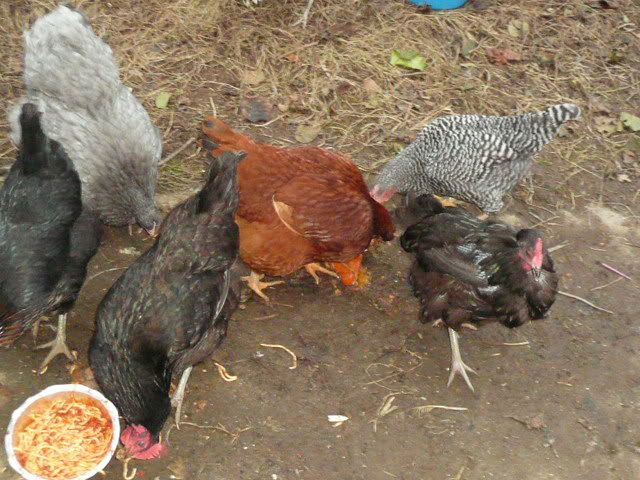
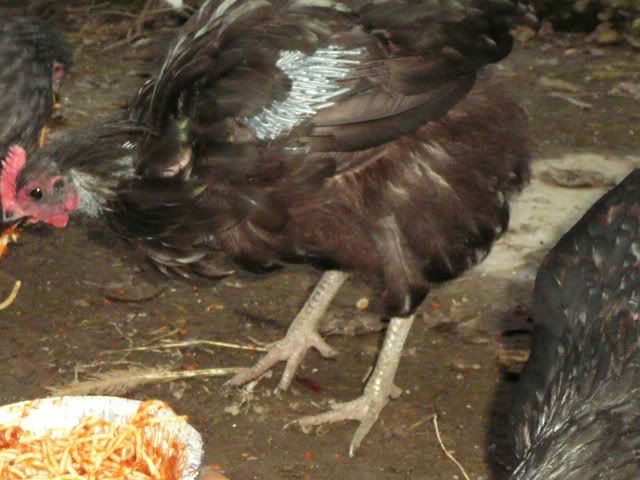
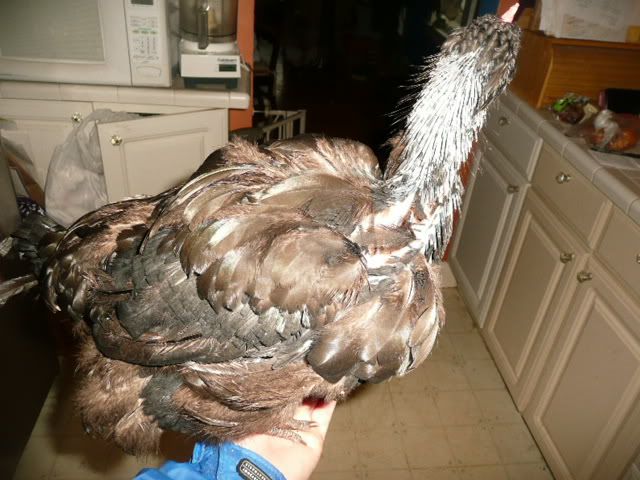
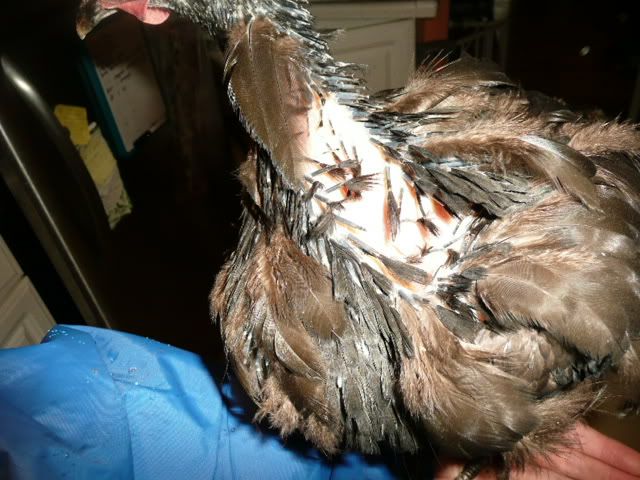
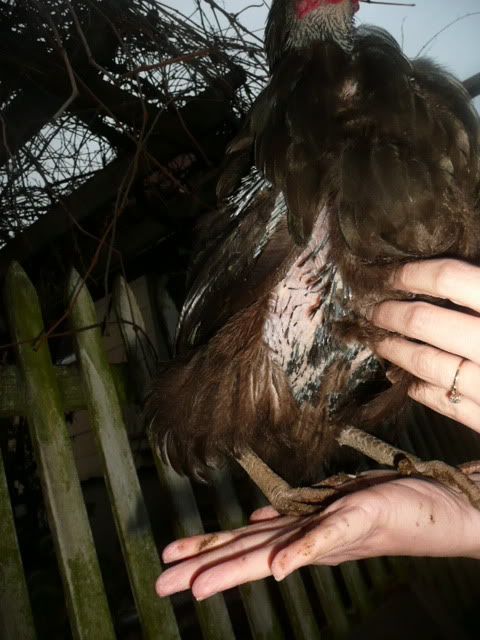
The cochin & Polish cresteds molted first, followed in close succession by the production birds. As was the case last year, the australorps (black hens) were the last to go. Also like last year, they look miserable: they're ratty and have broad swathes of bare skin in 40-degree weather. We've found, too, that our normally friendly birds shy away from being touched when they molt. It's got to be an uncomfortable process for them.
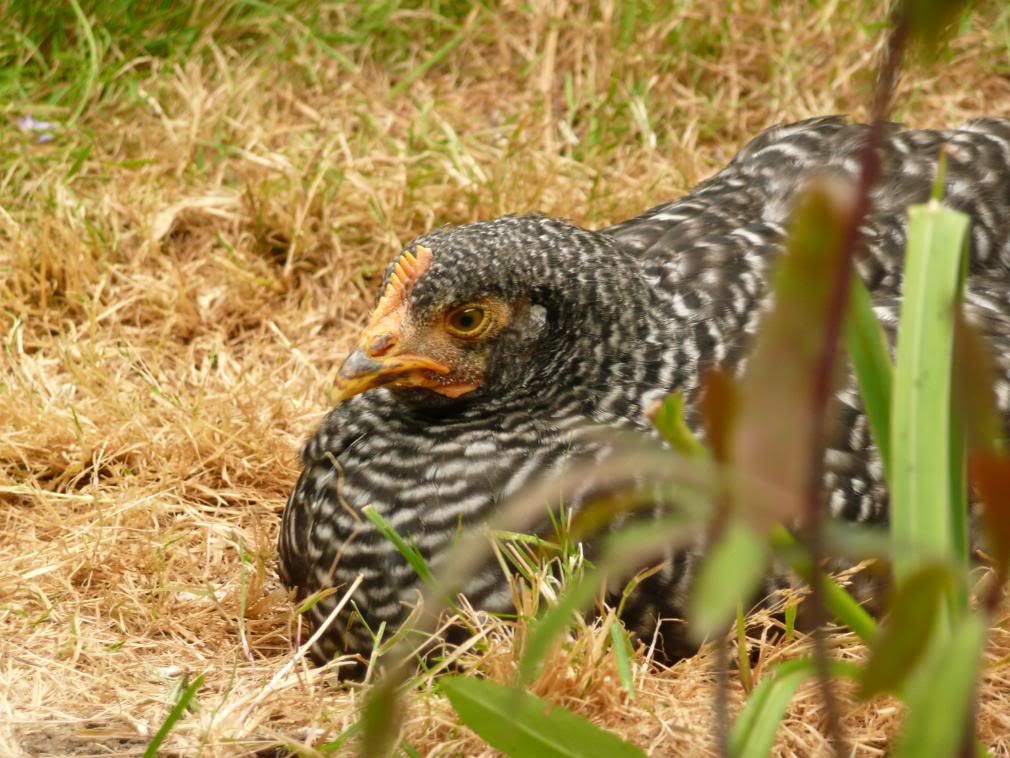
This is a pic I took of Croquette about this time last year (click link for more pics). She and Miss Piggy, our other australorp, look like this again now. Croquette has taken to standing in the middle of the yard, one leg pulled up to conserve heat, looking cranky. There's nothing we can do for her but offer our sympathy.
When Gene and I first got chickens a few years ago, we made the decision not to force them to lay during the winter. I'm rethinking that choice now, especially since they eat 50 pounds of feed each month at a cost of about $17. Freeloaders. Frankly, it's annoying to buy eggs at the grocery store when you know there's a flock of hens in your own yard.
So how come hens don't lay in the winter? If you think about it from a biological perspective, it makes perfect sense: it takes warmth and ample food to raise chicks. Neither of these things is available during the winter months so when the hours of daylight dwindle to less than 12 hours, hens' laying tapers off until it stops completely. As the hours increase in the spring, the production of eggs follows.
Modern chickens have been bred into two categories: ornamental and production. Ornamental birds, like our cochin and two Polish, tend to lay less frequently, go broody (i.e. desire to hatch eggs), and "switch off" for a longer period during the winter. Production birds, as the name implies, lay more eggs per week for more months of the year. Our nine-hen flock has six production birds: buff orpington, black star, Rhode Island Red, barred Plymouth Rock, and two australorps. They're the workhorses of the group. Other common ornamentals include "silkies" and others. Most of the birds you find in feed stores are production birds, though ornamentals are increasingly more common.
We've definitely seen the difference between our breeds. Beaker, one of our Polish cresteds, spent much of the summer trying to hatch the other girls' eggs or even sitting in an empty nesting box. When she finally quit being broody, she laid a half-dozen eggs, then molted. We'd get another standard cochin in a heartbeat - they're sweet, gentle, curious birds who don't mind being handled by children - but probably won't get any more Polish. The Polish are noisy, neurotic, and poor layers. That said, they're easy to catch because they can't see anything!
As an aside, we used to have a bantam cochin, who was also gentle with kids. Tribble's short legs, feathered feet, and our rainy climate meant that moisture wicked up onto her body all winter. She hated the rain and we constantly struggled with mite infestations on her.
Getting back to my point about laying cycles: it is possible to get the hens to lay during the winter. We've decided that the girls will get a much-needed break through December. They laid well last summer and we believe it's important to give their bodies a rest. Come the New Year, we're going to put lights in their coop to encourage production. Twelve to fourteen hours of light are needed to get them to lay. The sun sets around 4:30 p.m. here in January, so we'll turn on the light in the coop from 3:30 until 7:00 a.m., then allow the natural daylight to take over for the rest of the day. It's best to have the light in the morning to avoid the coop going dark before the girls have had a chance to get onto the roost.
Have you used supplemental lighting to encourage egg production in your backyard flock? How were your results?
Doing our best to eat locally and sustainably, raising our own food on a small lot in the city, making hand-crafted cuisine, and keeping it real.
Showing posts with label eggs. Show all posts
Saturday, December 3, 2011
Friday, March 11, 2011
A tale of eggs & banana bread
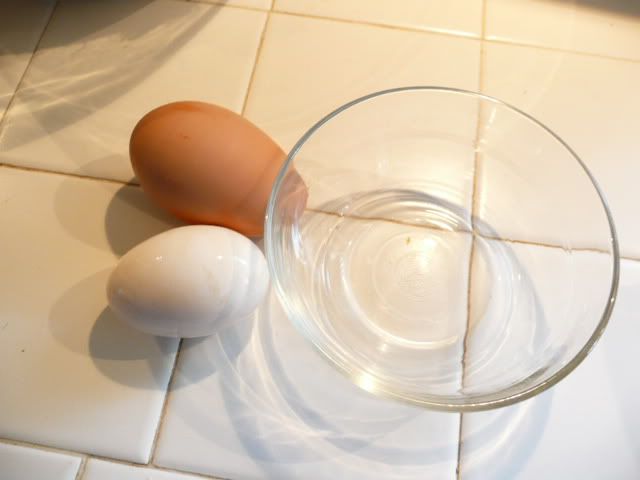
We got a ginormous egg about a week ago. It weighed about 100 grams, which is about 50% larger than our normal eggs.
Here it is next to a medium egg from one of our Polish hens (btw, who says Polish hens can't lay big eggs?).
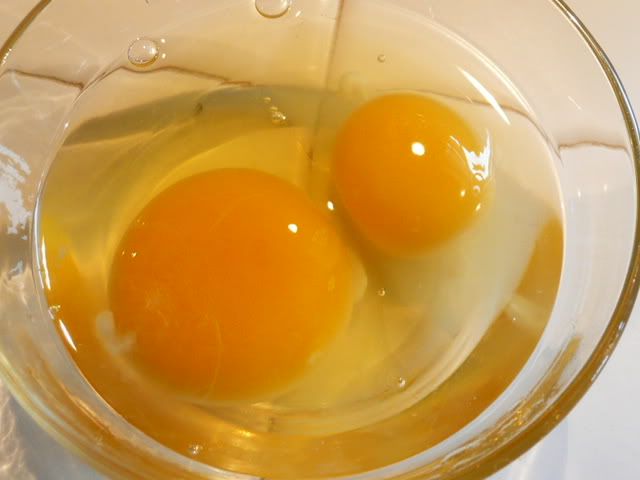
Some people insisted it was a double-yolker. We don't get those very frequently, so I cracked it open to see what was inside.
That has got to be the biggest yolk I've ever seen. The yolk next to it is a normal size. The big one was probably 1.5 inches across. Massive!
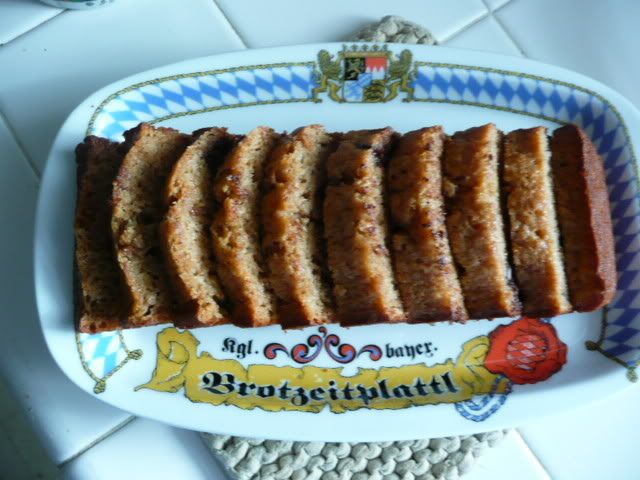
It did, however, make some pretty awesome banana bread.
BANANA BREAD (adapted slightly from CookingLight.com)
1 1/2 cups mashed ripe banana
1/3 cup lowfat sour cream
5 tablespoons butter, melted
2 large eggs
1/2 cup granulated sugar
1/2 cup packed brown sugar
3.75 ounces all-purpose flour
3 ounces whole wheat flour
3/4 teaspoon baking soda
1/2 teaspoon salt
1/2 teaspoon ground cinnamon
Cooking spray
Chocolate chips - optional
1. Preheat oven to 350°.
2. Combine first 4 ingredients in a large bowl; beat with a mixer at medium speed. Add granulated and brown sugars; beat until combined.
3. Combine flours and next 3 ingredients. Add flour mixture to banana mixture; beat just until blended. Pour batter into a 9 x 5-inch loaf pan coated with cooking spray. Bake at 350° for 55 minutes or until a wooden pick inserted in center comes out clean. Remove from oven; cool 10 minutes in pan on a wire rack. Remove bread from pan; cool completely.
Here it is next to a medium egg from one of our Polish hens (btw, who says Polish hens can't lay big eggs?).
Some people insisted it was a double-yolker. We don't get those very frequently, so I cracked it open to see what was inside.
That has got to be the biggest yolk I've ever seen. The yolk next to it is a normal size. The big one was probably 1.5 inches across. Massive!
It did, however, make some pretty awesome banana bread.
BANANA BREAD (adapted slightly from CookingLight.com)
1 1/2 cups mashed ripe banana
1/3 cup lowfat sour cream
5 tablespoons butter, melted
2 large eggs
1/2 cup granulated sugar
1/2 cup packed brown sugar
3.75 ounces all-purpose flour
3 ounces whole wheat flour
3/4 teaspoon baking soda
1/2 teaspoon salt
1/2 teaspoon ground cinnamon
Cooking spray
Chocolate chips - optional
1. Preheat oven to 350°.
2. Combine first 4 ingredients in a large bowl; beat with a mixer at medium speed. Add granulated and brown sugars; beat until combined.
3. Combine flours and next 3 ingredients. Add flour mixture to banana mixture; beat just until blended. Pour batter into a 9 x 5-inch loaf pan coated with cooking spray. Bake at 350° for 55 minutes or until a wooden pick inserted in center comes out clean. Remove from oven; cool 10 minutes in pan on a wire rack. Remove bread from pan; cool completely.
This is a bread plate I bought for my grandma in Bavaria some years ago. I recently retrieved it when she moved into assisted living. Perfect for a small loaf of bread while paying a visit to friends!
Wednesday, March 9, 2011
Pancetta and bacon update
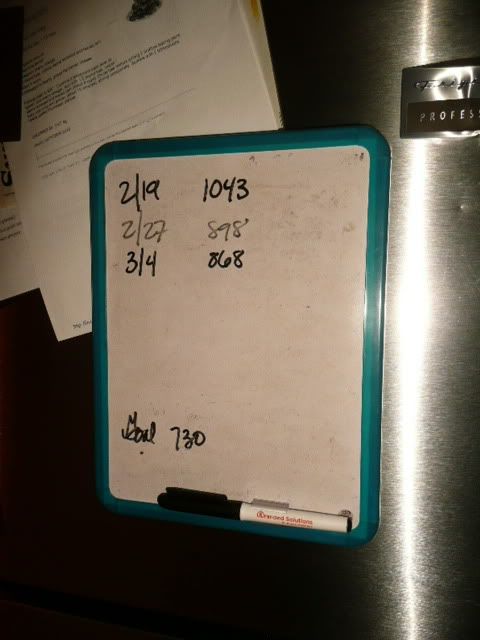
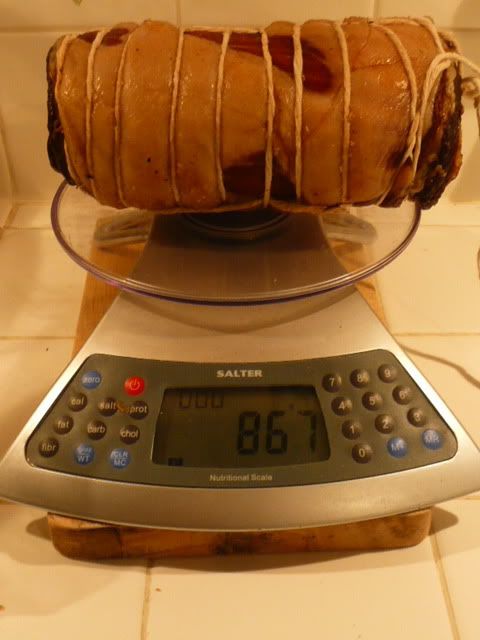
My pancetta started out on February 19 at 1043 grams, or a little over 2 1/4 pounds. I'm glad I wrote down the dates.
As you can see, it's just 868 as of last weekend whereas it should be closer to 730.
Our weather went through a very dry and cold spell. According to what I've read, the meat may have developed a crust on it, which isn't allowing the moisture to escape any longer.
The remedy is to wrap the meat in plastic, put it in the fridge for a few days to allow the moisture in the meat to redistribute, then hang it back up again. And that's what I've done.
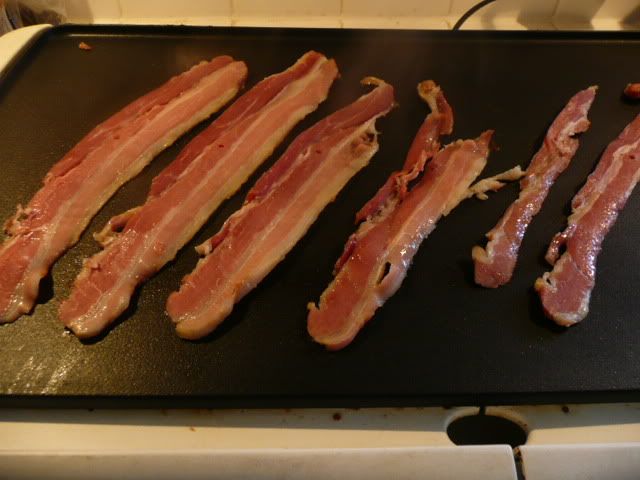
My bacon, on the other hand, is a whole other delicious story. Last weekend I cut off a few slices and cooked them on the griddle. The meat is much leaner than store bacon. Nicely done, Lisa!
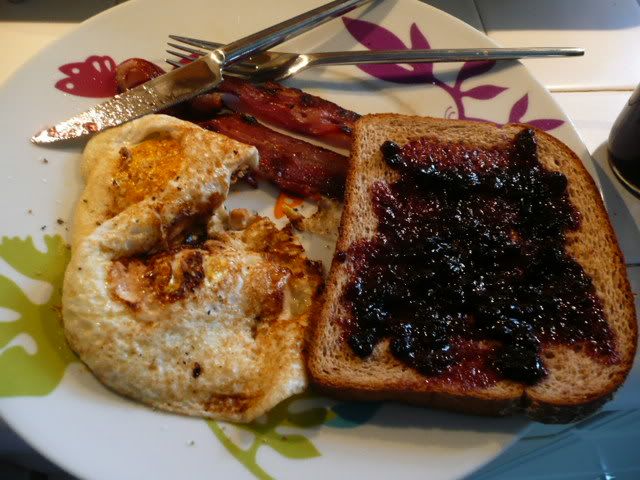
Gene and I had that bacon with fresh eggs from our girls, Poulsbo bread toast, and blueberry citrus conserves I canned (they're my favorite).
Monday, February 28, 2011
Poached eggs on toast
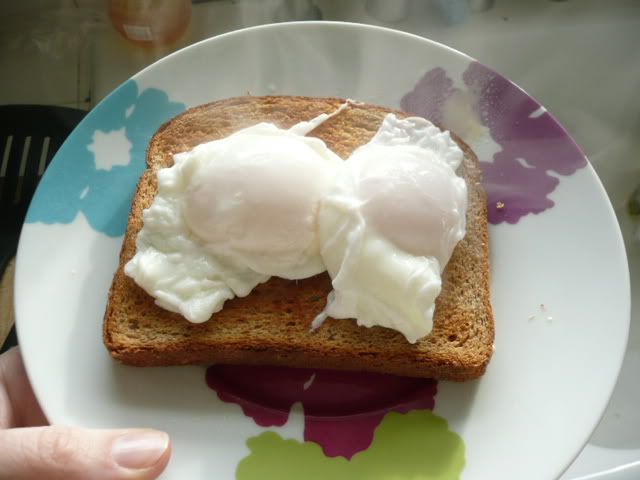
Poached eggs on toast have long been one of my favorite meals. Our hens are laying again after a 6-week period of no eggs. Some of our girls stopped laying in late October or November, meaning that they took over 3 months of vacation. It's about time they started paying their rent again. Not only are we eating our own eggs instead of storebought ones, I'm able to sell eggs again.
Hint... hint... if any of my Tacoma readers want naturally nested, cage-free, free-range, humanely raised eggs from hens with names, let me know. At $4/dozen they're less than at the closed-for-the-season Broadlway farmers market.
And to you midwesterners selling your eggs for $2/dozen, shush. This is the city.
Anyway, poached eggs are simple and quick to make. You can go from conceptualization to digestion in maybe 8 minutes. With the egg already perched on top of the toast, there's no chance of that delicious, runny yolk going to waste. Just a little salt and pepper makes this the perfect meal.
Poached eggs
Eggs
Toast
Bring water to a low boil (hot enough so that it bubbles but isn't violently boiling) in a saucepan. Crack your eggs into a small bowl or cup. Slowly tip your cup into the water and allow the egg to slide in. Since the water is on a low boil, the egg shouldn't go far.
Some people swear by the swirling water method, which I think is pretty silly. Don't bother.
Cook your egg to the desired doneness. For me this took maybe 3-4 minutes. I've always loved runny, goopy egg yolks.
Scoop the egg out of the water with a slotted spoon and serve on hot toast with salt, pepper, and/or hot sauce. Heck, go crazy and dump some hollandaise on there if you need the extra calories in your diet.
Bread: Poulsbo Bread
Eggs: from our yard, I think Beaker & Dozer laid these
UPDATED around 5:20 p.m. - Friends have been asking me on my personal Facebook page how I did this. [shrug] I've never had poached eggs go wrong so it never occurred to me that they could. I think that the key lies in a low cooking temperature. Don't let your water come to a full boil. See this link for pictures of water at various cooking temps.
Something my dad always does, which I never do anymore, is to submerge the entire egg (in shell) into a pot of boiling water for roughly 30 seconds. His eggs always turned out well. In retrospect I think it may function to coagulate the egg white a bit, helping it stay together in the water while being poached.
Hint... hint... if any of my Tacoma readers want naturally nested, cage-free, free-range, humanely raised eggs from hens with names, let me know. At $4/dozen they're less than at the closed-for-the-season Broadlway farmers market.
And to you midwesterners selling your eggs for $2/dozen, shush. This is the city.
Anyway, poached eggs are simple and quick to make. You can go from conceptualization to digestion in maybe 8 minutes. With the egg already perched on top of the toast, there's no chance of that delicious, runny yolk going to waste. Just a little salt and pepper makes this the perfect meal.
Poached eggs
Eggs
Toast
Bring water to a low boil (hot enough so that it bubbles but isn't violently boiling) in a saucepan. Crack your eggs into a small bowl or cup. Slowly tip your cup into the water and allow the egg to slide in. Since the water is on a low boil, the egg shouldn't go far.
Some people swear by the swirling water method, which I think is pretty silly. Don't bother.
Cook your egg to the desired doneness. For me this took maybe 3-4 minutes. I've always loved runny, goopy egg yolks.
Scoop the egg out of the water with a slotted spoon and serve on hot toast with salt, pepper, and/or hot sauce. Heck, go crazy and dump some hollandaise on there if you need the extra calories in your diet.
Bread: Poulsbo Bread
Eggs: from our yard, I think Beaker & Dozer laid these
UPDATED around 5:20 p.m. - Friends have been asking me on my personal Facebook page how I did this. [shrug] I've never had poached eggs go wrong so it never occurred to me that they could. I think that the key lies in a low cooking temperature. Don't let your water come to a full boil. See this link for pictures of water at various cooking temps.
Something my dad always does, which I never do anymore, is to submerge the entire egg (in shell) into a pot of boiling water for roughly 30 seconds. His eggs always turned out well. In retrospect I think it may function to coagulate the egg white a bit, helping it stay together in the water while being poached.
Thursday, January 6, 2011
Julia Child's Ratatouille
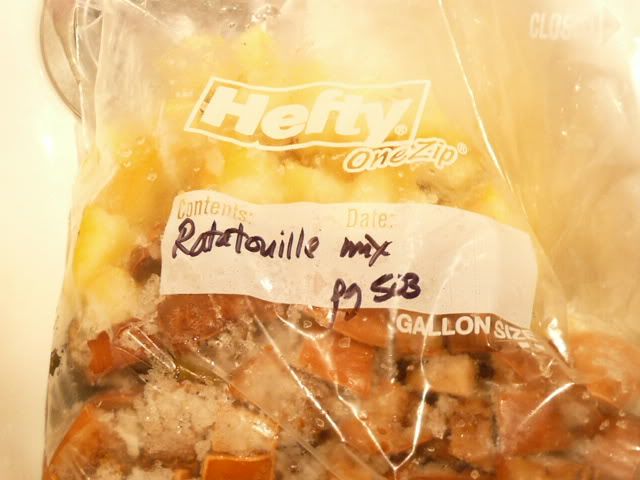
Last summer I bought a butt load of eggplants. I chopped them up with my bumper crop of yellow squash and froze 3 bags like this one. Notice that it says "pg 503" ?
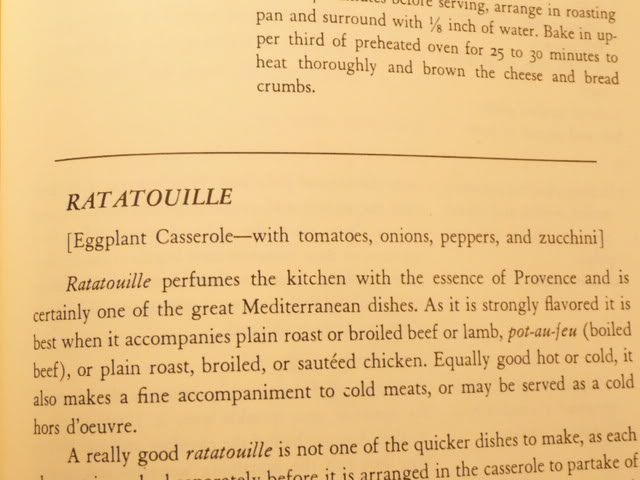
This is page 503:
I was fortunate enough to live in France for 10 months, 8 of that spent with a French family who adopted me. The matriarch of the family, Marie-Claude, is a warm, generous, and kind person who is still a close friend. M-C taught me many of the things I know about cooking, including how to make ratatouille. Much of what I cook, both in technique and ingredients, comes from her influence.
Ratatouille is made from tomatoes, squash, eggplant, and bell peppers, all late summer harvest items. It's from the south of France, which is the warm region where these things grow well. When I bagged up the yellow squash from my yard and the farmers market eggplant last summer, it was an experiment to see if I could recapture that late summer flavor of savory vegetables in the bleak winter months of roots and hard squash.
You can download a copy of the Julia Child recipe here.
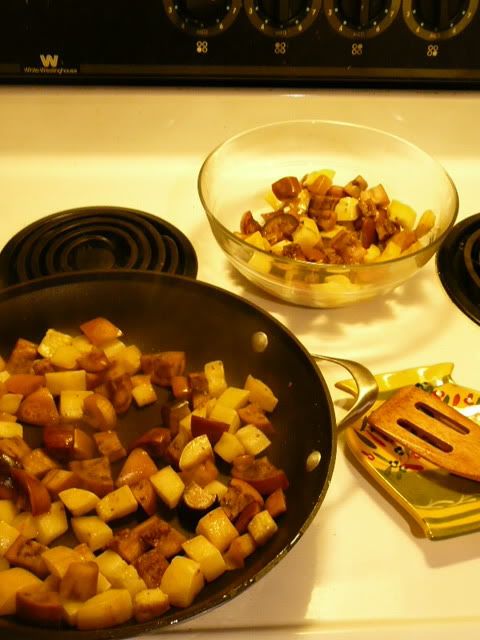
I started by cooking the eggplant in oil:
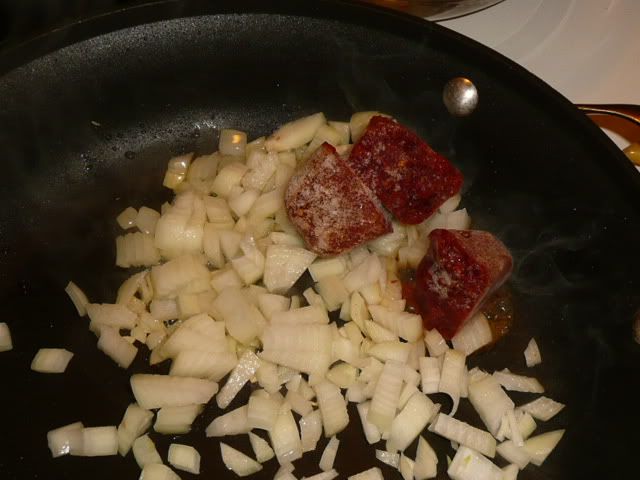
Next I cooked the onions with 3 of my fire-roasted red pepper cubes because fresh local bell peppers do not exist in Washington in January.
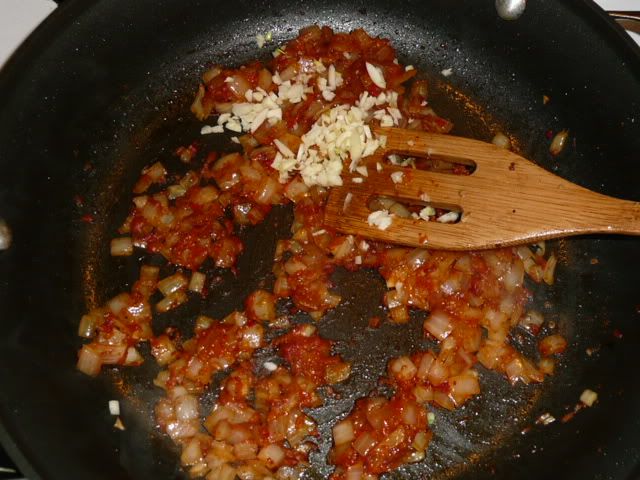
Once that was all cooked, I added the garlic.
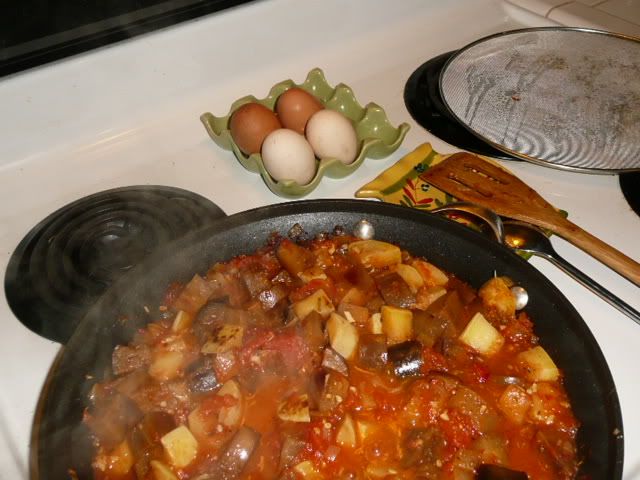
From there, I added a jar of tomatoes I had canned last summer, returned the eggplant to the pan, and seasoned it. I could tell that Julia's ratatouille wasn't going to be as good as Marie-Claude's (sorry, Julia). I added some herbes de Provence and red pepper flakes as well as extra salt and pepper.
I let it simmer, covered by a splatter guard, for about 20 minutes.
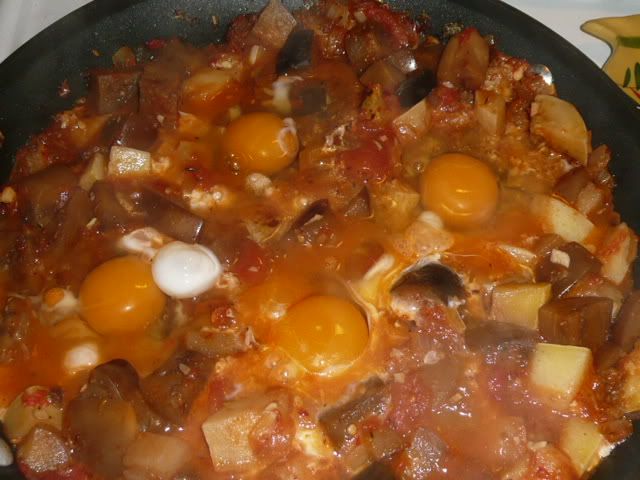
My last act was to top the ratatouille with 4 eggs and let them poach in the sauce, covered, for about 5 minutes.
Ratatouille with eggs is the only way I ever had this dish in France, and it's how I prefer it. The slightly runny yolks add a creaminess to the ratatouille's flavor, as well as contribute protein.
Of course, I had to have some red wine with dinner!
So did I recreate a summer dish in the winter? The answer is yes and no. The eggplant was brown and unappealing, I think due to having been frozen and my not having drained it fully. The yellow squash, however, was still very flavorful and I found myself digging in my bowl for just the squash. The chickens got the eggplant and gladly ate it. They don't get much in the way of veggies during the winter.
I still have 2 bags of the ratatouille mix in the freezer. I'm going to try a recipe from my French Cooking cookbook, which I recently pulled from my library for the mousse au chocolat basque. I'll let you know when I do.
This is page 503:
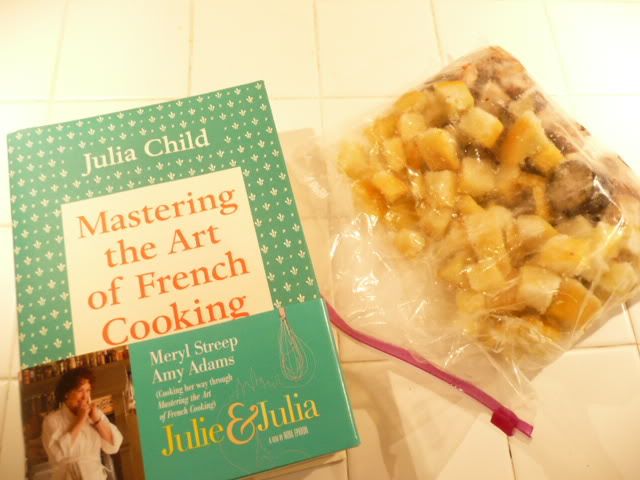
From this famous book:
I was fortunate enough to live in France for 10 months, 8 of that spent with a French family who adopted me. The matriarch of the family, Marie-Claude, is a warm, generous, and kind person who is still a close friend. M-C taught me many of the things I know about cooking, including how to make ratatouille. Much of what I cook, both in technique and ingredients, comes from her influence.
Ratatouille is made from tomatoes, squash, eggplant, and bell peppers, all late summer harvest items. It's from the south of France, which is the warm region where these things grow well. When I bagged up the yellow squash from my yard and the farmers market eggplant last summer, it was an experiment to see if I could recapture that late summer flavor of savory vegetables in the bleak winter months of roots and hard squash.
You can download a copy of the Julia Child recipe here.
I started by cooking the eggplant in oil:
Next I cooked the onions with 3 of my fire-roasted red pepper cubes because fresh local bell peppers do not exist in Washington in January.
Once that was all cooked, I added the garlic.
From there, I added a jar of tomatoes I had canned last summer, returned the eggplant to the pan, and seasoned it. I could tell that Julia's ratatouille wasn't going to be as good as Marie-Claude's (sorry, Julia). I added some herbes de Provence and red pepper flakes as well as extra salt and pepper.
I let it simmer, covered by a splatter guard, for about 20 minutes.
My last act was to top the ratatouille with 4 eggs and let them poach in the sauce, covered, for about 5 minutes.
Ratatouille with eggs is the only way I ever had this dish in France, and it's how I prefer it. The slightly runny yolks add a creaminess to the ratatouille's flavor, as well as contribute protein.
Of course, I had to have some red wine with dinner!
So did I recreate a summer dish in the winter? The answer is yes and no. The eggplant was brown and unappealing, I think due to having been frozen and my not having drained it fully. The yellow squash, however, was still very flavorful and I found myself digging in my bowl for just the squash. The chickens got the eggplant and gladly ate it. They don't get much in the way of veggies during the winter.
I still have 2 bags of the ratatouille mix in the freezer. I'm going to try a recipe from my French Cooking cookbook, which I recently pulled from my library for the mousse au chocolat basque. I'll let you know when I do.
Ingredient break-down:
LOCAL: All veggies and herbs, eggs, wine
NOT LOCAL: Oil, salt, pepper
Tuesday, January 4, 2011
Mousse au chocolat basque
Last week my cousin and I were talking about different kinds of foods. To make a long story short, she confided in me that she'd never had French food. Having lived in France and learned from a very skilled French woman how to cook a variety of things, I was stunned! How can anyone never have had French cuisine?!?
Worse yet, how could I not have introduced my family to a cuisine that I love?
Off we went a week later for dinner at a local French restaurant recommended by friends. We enjoyed a good meal that ended with our sharing of a mousse au chocolat and a lemon tart.
I was disappointed by the mousse au chocolat. It felt "puny" in my mouth and had no oompf or texture. Yes, I know that "mousse" means "foam" but I'm used to mousses that are silken and creamy, not airy and meh.
Mousse gets its texture from the air bubbles suspended in a sweet medium. You can use whipped cream or egg whites when making a mousse au chocolat. Most recipes I see for mousse use whipped cream, which I don't think provides that unctuous creaminess you want from a mousse.
Here's my favorite recipe for mousse au chocolate, taken from French Cooking: Traditional recipes for the contemporary cook, the first French cookbook I ever bought. This cookbook deserves a look because the traditional French recipes are expert at showcasing local and seasonal ingredients.
Turns out that the amount of chocolate is variable depending upon your taste... or memory. I didn't consult the book before delving in and used just half of the chocolate. And I forgot the butter. But a friend at the dinner party said, "I would sell children for this." High praise.
Use a high quality chocolate because its flavor will be in the limelight. The recipe scales up easily, just remember this ratio -
My counter has a slight bullnose on it. I whip out the pounder thingy and whack the crap out of the chocolate while it's still in the package. Way easier than chopping it.
I'm submitting this as a Dark Days Challenge recipe because it uses just 3 ingredients: butter, eggs, and chocolate, any 2 of which are easy to get locally.
MOUSSE AU CHOCOLAT BASQUE
This rich mousse is silken, dense, and decadent. A little goes a long way, helping to keep portion sizes small.
6oz semi-sweet chocolate
1 tbsp water
1 tbsp butter
3 eggs, separated, room temperature
(optional) 2 tbsp liqueur of choice
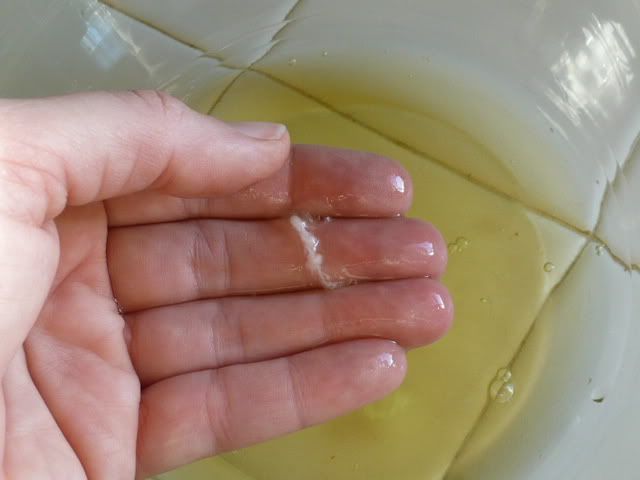
When you separate the eggs, make sure to remove the chalaza, that white squiggly thing attached to the yolk. You don't want someone who is in the middle of a foodgasm to stop and pull a funky white thing out of their mouth. Believe me - this happened to me once. Moussus interruptus is bad mojo.
Break or chop the chocolate and put into a microwaveable bowl with the water. Zap for 30 seconds, then stir well. Zap longer if needed to melt but don't burn the chocolate.
Allow to cool slightly then add the butter, egg yolks one at a time, and the optional liqueur.
Beat the egg yolks into submission. I had to do mine by hand because I got rid of my hand mixer last summer. Can I count that toward my exercise regime?
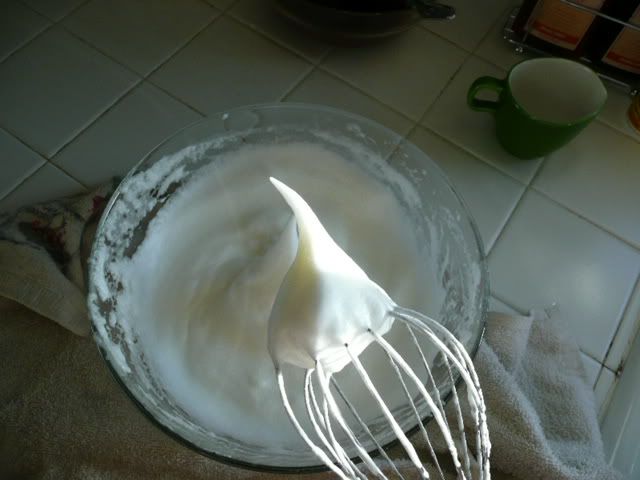
Gently... gently... fold the egg whites into the chocolate one third at a time. Don't try to get an even color throughout: doing so will release too many of the bubbles trapped in the egg whites.
Pour the mousse into your desired vessel(s) and chill overnight. I did one that was with Grand Marnier and another with the brandy I'd soaked my currants in for the Christmas Stollen. The original recipe suggests rum and I've also seen people use Chartreuse, which is from the region where I lived. On a side note, my friend is the head guide for the Chartreuse aging caves. It's an acquired taste but good once you've acquired it!
I promise you that this will be the best chocolate mousse you've ever had. I once made it for friends in France and they asked me for the recipe.
Worse yet, how could I not have introduced my family to a cuisine that I love?
Off we went a week later for dinner at a local French restaurant recommended by friends. We enjoyed a good meal that ended with our sharing of a mousse au chocolat and a lemon tart.
I was disappointed by the mousse au chocolat. It felt "puny" in my mouth and had no oompf or texture. Yes, I know that "mousse" means "foam" but I'm used to mousses that are silken and creamy, not airy and meh.
Mousse gets its texture from the air bubbles suspended in a sweet medium. You can use whipped cream or egg whites when making a mousse au chocolat. Most recipes I see for mousse use whipped cream, which I don't think provides that unctuous creaminess you want from a mousse.
Here's my favorite recipe for mousse au chocolate, taken from French Cooking: Traditional recipes for the contemporary cook, the first French cookbook I ever bought. This cookbook deserves a look because the traditional French recipes are expert at showcasing local and seasonal ingredients.
Turns out that the amount of chocolate is variable depending upon your taste... or memory. I didn't consult the book before delving in and used just half of the chocolate. And I forgot the butter. But a friend at the dinner party said, "I would sell children for this." High praise.
Use a high quality chocolate because its flavor will be in the limelight. The recipe scales up easily, just remember this ratio -
1 egg : 2 ounces chocolate = 2 servings
My counter has a slight bullnose on it. I whip out the pounder thingy and whack the crap out of the chocolate while it's still in the package. Way easier than chopping it.
I'm submitting this as a Dark Days Challenge recipe because it uses just 3 ingredients: butter, eggs, and chocolate, any 2 of which are easy to get locally.
MOUSSE AU CHOCOLAT BASQUE
This rich mousse is silken, dense, and decadent. A little goes a long way, helping to keep portion sizes small.
(Yes, the girls' eggs really are that bright orange! Booze is all optional.)
6oz semi-sweet chocolate
1 tbsp water
1 tbsp butter
3 eggs, separated, room temperature
(optional) 2 tbsp liqueur of choice
When you separate the eggs, make sure to remove the chalaza, that white squiggly thing attached to the yolk. You don't want someone who is in the middle of a foodgasm to stop and pull a funky white thing out of their mouth. Believe me - this happened to me once. Moussus interruptus is bad mojo.
Break or chop the chocolate and put into a microwaveable bowl with the water. Zap for 30 seconds, then stir well. Zap longer if needed to melt but don't burn the chocolate.
Allow to cool slightly then add the butter, egg yolks one at a time, and the optional liqueur.
Beat the egg yolks into submission. I had to do mine by hand because I got rid of my hand mixer last summer. Can I count that toward my exercise regime?
Gently... gently... fold the egg whites into the chocolate one third at a time. Don't try to get an even color throughout: doing so will release too many of the bubbles trapped in the egg whites.
Pour the mousse into your desired vessel(s) and chill overnight. I did one that was with Grand Marnier and another with the brandy I'd soaked my currants in for the Christmas Stollen. The original recipe suggests rum and I've also seen people use Chartreuse, which is from the region where I lived. On a side note, my friend is the head guide for the Chartreuse aging caves. It's an acquired taste but good once you've acquired it!
I promise you that this will be the best chocolate mousse you've ever had. I once made it for friends in France and they asked me for the recipe.
Wednesday, December 22, 2010
Dark Days Frittata
As you may know, hubbie and I keep 9 hens on our wee urban lot in our city of 200,00 inhabitants. These girls provide us with an abundance of eggs... unless they're molting. Then they don't lay at all.
Of our nine hens, six are "production" birds, which typically lay 4-6 eggs/week all year-round. The other three are ornamentals and lay from 2-4/week starting in about April or May and going until October or so. Lately only Gwen and Nugget have been laying - all the girls had really hard molts this fall - but it's still enough to provide our household of two with enough eggs for eating and baking.
And these eggs are the perfect Dark Days Challenge food.
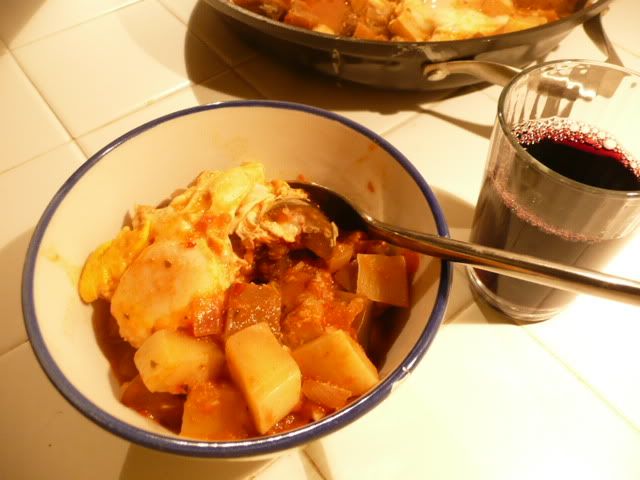
Here's a frittata that I made. I guess it's technically a frittata because there is no bread in it, which would make it a strata, nor does it have a crust, which would make it a quiche.
Dark Days Frittata
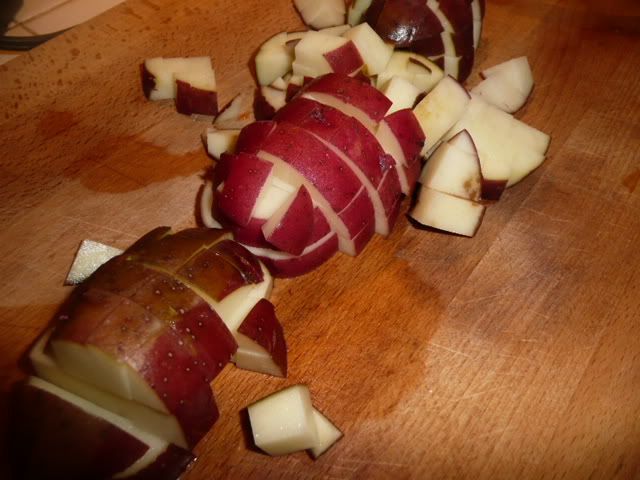
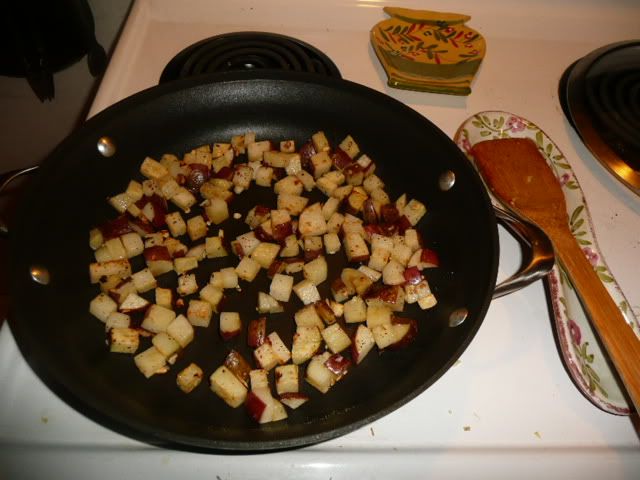
I started by dicing and cooking some red potatoes from our garden.
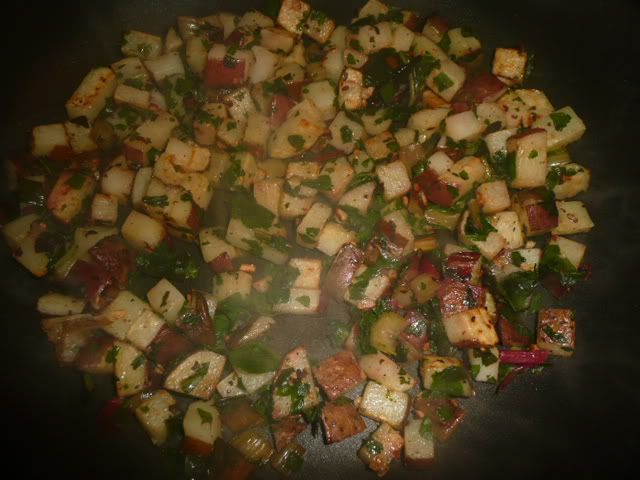
Then I added some chopped kale and garlic.
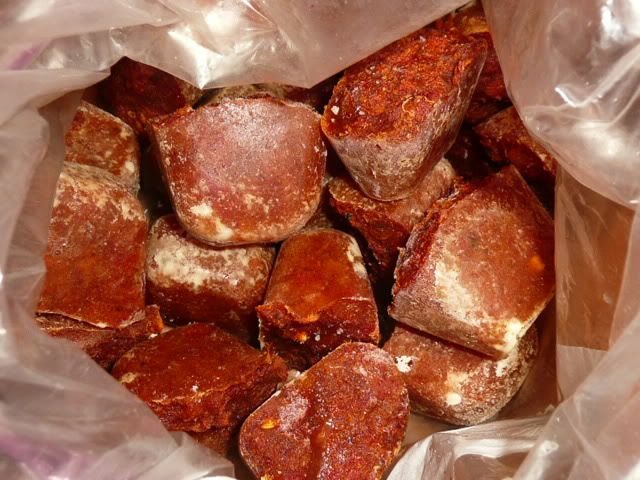
I decided that I was going for kind of a southwest-y flavor, so grabbed one of my roasted red pepper ice cubes from the freezer.
... popped it into the microwave for 30 seconds...
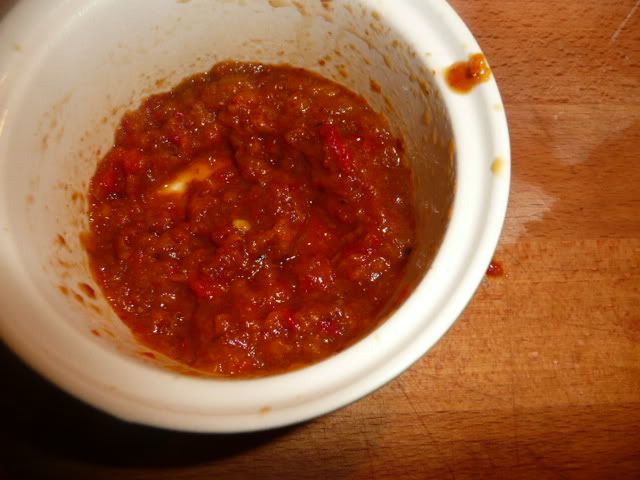
... then beat it with about six eggs, some salt, and pepper. Next time I'll use 2-3 of the cubes because the flavor got lost amongst the other things.
I poured the eggs over the potato mixture, then topped with some cheese. I think this is more of the queso fresco I've had for a while.
Bake at 350 for 30-40 minutes and voila! I topped it with some cilantro that had been languishing in my fridge. The cilantro and cheese were the only non-local ingredients.
Ingredient break-down:
Local: eggs, potato, red peppers, garlic
Not local: salt, pepper, cilantro, cheese
Of our nine hens, six are "production" birds, which typically lay 4-6 eggs/week all year-round. The other three are ornamentals and lay from 2-4/week starting in about April or May and going until October or so. Lately only Gwen and Nugget have been laying - all the girls had really hard molts this fall - but it's still enough to provide our household of two with enough eggs for eating and baking.
And these eggs are the perfect Dark Days Challenge food.
Here's a frittata that I made. I guess it's technically a frittata because there is no bread in it, which would make it a strata, nor does it have a crust, which would make it a quiche.
Dark Days Frittata
I started by dicing and cooking some red potatoes from our garden.
I cooked them up in my favorite skillet.
Then I added some chopped kale and garlic.
I decided that I was going for kind of a southwest-y flavor, so grabbed one of my roasted red pepper ice cubes from the freezer.
... popped it into the microwave for 30 seconds...
... then beat it with about six eggs, some salt, and pepper. Next time I'll use 2-3 of the cubes because the flavor got lost amongst the other things.
I poured the eggs over the potato mixture, then topped with some cheese. I think this is more of the queso fresco I've had for a while.
Bake at 350 for 30-40 minutes and voila! I topped it with some cilantro that had been languishing in my fridge. The cilantro and cheese were the only non-local ingredients.
Ingredient break-down:
Local: eggs, potato, red peppers, garlic
Not local: salt, pepper, cilantro, cheese
Sunday, December 12, 2010
There's a naked chick in my back yard
Can you pick out the molting hen?
People always are interested - or at least politely feign interest - when I talk about the quirks of having chickens. For example, many are suprised by the following factoids:
About 2 months ago I opened the coop one day to find a "puddle" of feathers under one of the girls. She trailed feathers after her like Pig Pen from Peanuts trails dust. It was weird. One after one, each of the girls molted. Egg production tanked and at one point we were getting just 3-4 eggs per week. Mind you, we have 9 hens. After Gwen, one of our favs, molted, I thought they were done.
I was wrong. Croquette started to molt in earnest.
Croquette, who'd had a light molt earlier in the fall, must have decided that her plumage need a total revamp after seeing how great the other girls looked. As an australorp, she's got the softest feathers I've ever felt. They're not coarse, as are Curry's feathers (our buff orpington). They're even softer than Animal's, our blue cochin. But now they're all over the yard... and very very few are on her.
Of the 9 molts we saw this fall, Croquette's has been the worst by far. She actually has exposed skin, which none of the others had. The poor thing, I picked her up the other day and she was shivering. I've been thinking of going to Goodwill to grab a cheap stocking hat, cut holes in it for her head & wings, and put it on her. If it weren't raining so much I would.
I'm eager for her feathers to grow because I cringe every time I look at her. If you looked like this, you wouldn't want to lay eggs, either.
People always are interested - or at least politely feign interest - when I talk about the quirks of having chickens. For example, many are suprised by the following factoids:
- Some types of hens don't lay eggs in the winter while others do.
- Chickens will eat nearly anything, including meat.
- Chickens molt (shed all their feathers) and get new ones in the late fall or early winter.
- A molting hen doesn't lay eggs.
Croquette (center) is supposed to look like Miss Piggy (left)
About 2 months ago I opened the coop one day to find a "puddle" of feathers under one of the girls. She trailed feathers after her like Pig Pen from Peanuts trails dust. It was weird. One after one, each of the girls molted. Egg production tanked and at one point we were getting just 3-4 eggs per week. Mind you, we have 9 hens. After Gwen, one of our favs, molted, I thought they were done.
The silvery things are called "pin feathers". As they grow, feathers emerge from the skin in a sheath, which eventually falls off to expose the new feather.
I was wrong. Croquette started to molt in earnest.
What's funny is that her feathers are coming in the same way they did when she was a chick: in 2 vertical lines that look like suspenders.
Croquette, who'd had a light molt earlier in the fall, must have decided that her plumage need a total revamp after seeing how great the other girls looked. As an australorp, she's got the softest feathers I've ever felt. They're not coarse, as are Curry's feathers (our buff orpington). They're even softer than Animal's, our blue cochin. But now they're all over the yard... and very very few are on her.
The brown areas are the old feathers & the black areas on her wing are the new ones. Her neck is covered in pin feathers.
Of the 9 molts we saw this fall, Croquette's has been the worst by far. She actually has exposed skin, which none of the others had. The poor thing, I picked her up the other day and she was shivering. I've been thinking of going to Goodwill to grab a cheap stocking hat, cut holes in it for her head & wings, and put it on her. If it weren't raining so much I would.
The poor girl. If she didn't crap everywhere, I'd let her stay in the laundry room to be warm & dry.
I'm eager for her feathers to grow because I cringe every time I look at her. If you looked like this, you wouldn't want to lay eggs, either.
Tuesday, August 24, 2010
Recent egg recall
The recall of millions upon millions of eggs got me thinking: are the eggs from my flock safe? I believe they are. I tell people they are. But to be sure, I contacted MyPetChicken, which is where I got my chicks, to ask if they certify that their hens are salmonella-free.
Here's their response (emphasis mine):
And so, yes: my hens are salmonella-free.
Here's their response (emphasis mine):
Thanks for contacting My Pet Chicken. We test Salmonella-pullorum-typhoid clean, and are H5/H7 AI monitored. Salmonella is more of an issue with factory farmed birds, because the conditions they are kept in are simply terrible. In fact, this isn't an illness that passes hen to hen at all, but is usually passed when hens eat rat droppings. Yuck.
Presuming you are keeping your hens in clean conditions with fresh food and water, it is doubtful they would contract salmonella. A hen sick with salmonella would be immediately obvious to you: weak, purple-combed, diarrhea, reduced egg production. The illness was probably obvious to those at the factory farm, too--even if they didn't notice one more symptom of the many in their abused hens, surely they would have noticed the drop in production--so it's sort of terrifying to think they just kept selling their eggs. Worse, the supplier of the two factory farms on which the recent outbreaks occurred apparently has a long history of violations:
http://www.huffingtonpost.com/2010/08/22/egg-recall-supplier-violations_n_690400.html
If you are worried that your hens somehow have contracted this illness, you can always have them tested, but my guess is that eating your hens' eggs is probably the safest thing you or your friends could do. Actually, this salmonella outbreak on a commercial factory farm is another good reason to keep your own hens, because you can monitor their health personally, and you can control what feed they eat and the conditions they live in. You can see when they may need medical attention. If you know anything about factory farms, the surprising thing here is not that there was an outbreak, but that there aren't many, many more. Those poor chickens.
Best,I can confidently say that my hens are all healthy, as evidenced by perky appearances and alert behavior.
Lissa
http://www.mypetchicken.com/
And so, yes: my hens are salmonella-free.
Thursday, July 15, 2010
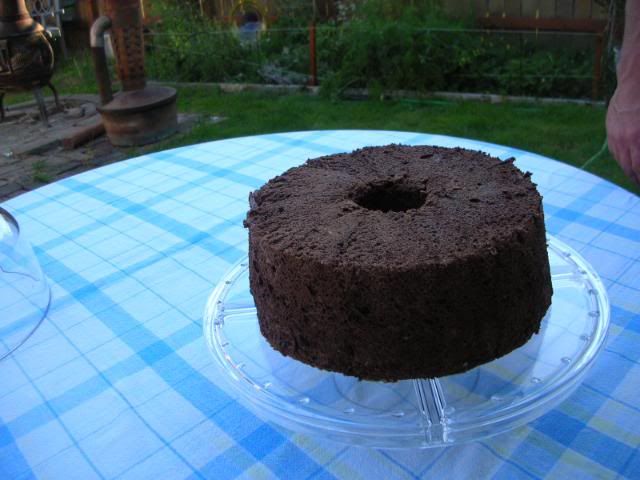
Chocolate Angel Food Cake
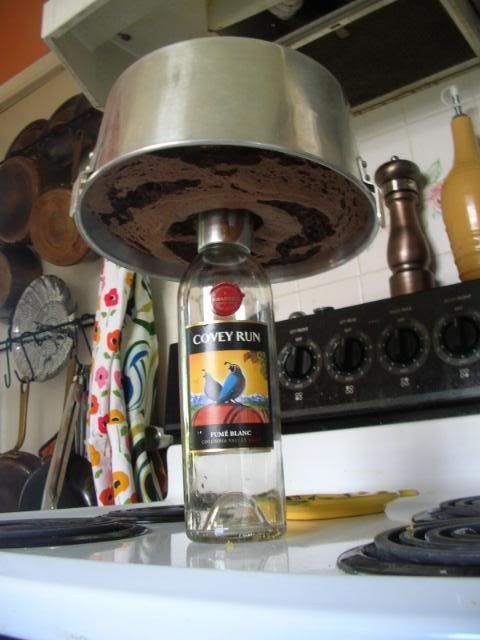
I don't really like wine. Really. I only choke it back for one reason: to have a place to cool angel food cake upsidedown.
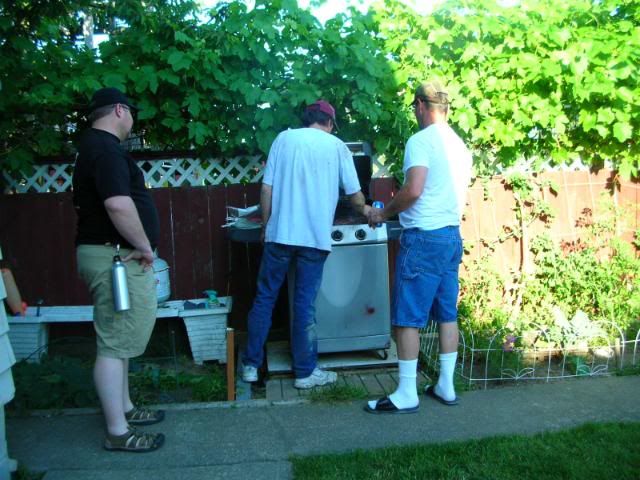
Our next-door neighbors invited us over for a BBQ last weekend. The men kept themselves busy with the meat.
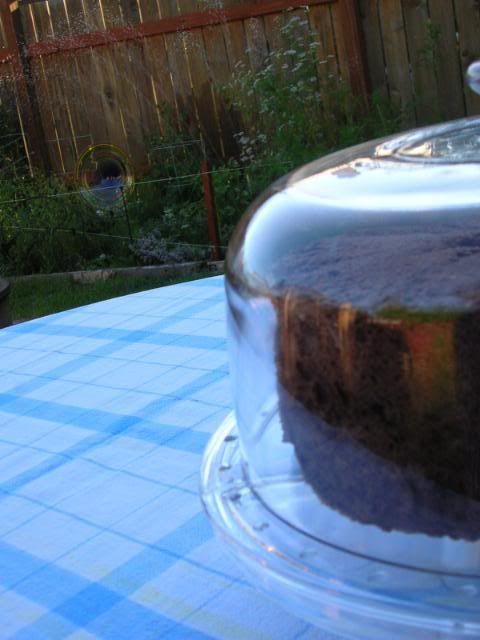
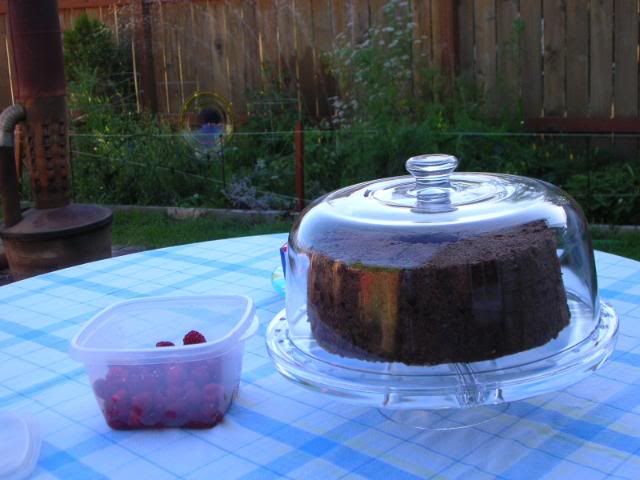
Even though we're not eating the girls' eggs right now, we still have a respectable inventory of them. Since angel food cake uses about 12 egg whites and we also had a ton of local berries, I made this:
Buddy wanted some, too.
Chocolate Angel Food Cake recipe
Note: I made it without cake flour and it was fine. I also forgot the cream of tartar. I did like the use of almond extract, something I hadn't seen in an angel food cake before.
I must go through 2-3 cooling bottles a week. Ahhh... the sacrifices we food bloggers make.
Seriously. I hate wine.
Our next-door neighbors invited us over for a BBQ last weekend. The men kept themselves busy with the meat.
Even though we're not eating the girls' eggs right now, we still have a respectable inventory of them. Since angel food cake uses about 12 egg whites and we also had a ton of local berries, I made this:
Buddy wanted some, too.
Chocolate Angel Food Cake recipe
Note: I made it without cake flour and it was fine. I also forgot the cream of tartar. I did like the use of almond extract, something I hadn't seen in an angel food cake before.
Wednesday, July 7, 2010
Meds and Dumpling
We're medicating the chickens because I think that Gwen has coccidiosis, an intestinal bacterial parasite. Because we lost a hen, Dumpling, in March 2009 to cocci and large roundworms, it's better safe than sorry.
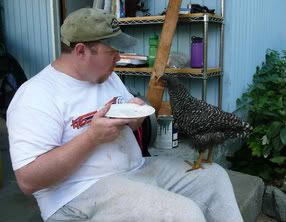
G-man was always Dumpling's favorite human and she was his favorite in return. She didn't care for me all that much but she adored him, following him around the yard and jumping into his lap any chance she got. In the above pic she was trying to help him finish his sandwich during a weekend work project 2 years ago.
Dumpling had been sick for a couple of days: listless, droopy, and almost zombie-like. I stayed up with her one night, giving her vitamins and water hourly. When G-man got up around 5a to check on us she'd been unresponsive for several hours, not even opening her eyes. G-man walked into the room and Dumpling lifted her head for the first time in nearly a day to look at him. Then she laid her head down on my chest, exhaled, and died.
We realized the extent of her parasitic infections too late to save her. RIP, Dumpling.
At the first sighting of blood in poop, a common symptom of cocci in chickens, I decided not to risk losing any more of our flock. Gwen hasn't been laying for quite some time, which is a symptom Dumpling shared. I medicated all 9 of the girls for both cocci and worms with Sulmet and Wazine. Because of the medications we can't eat any of the eggs for 2 weeks. We're giving them to our neighbors for their dogs.
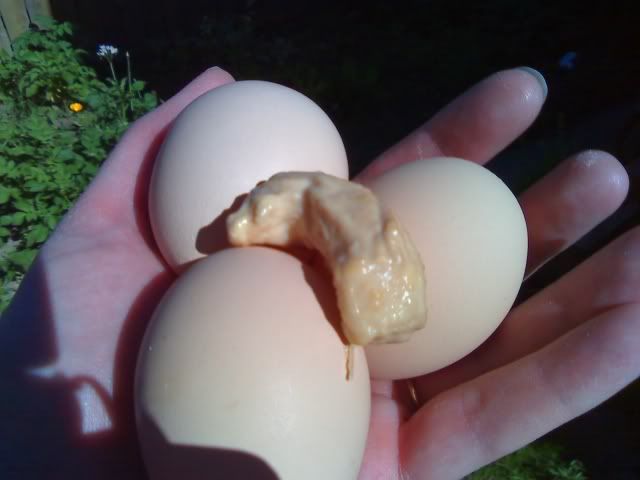
Ever since I started the meds we've gotten some weird eggs that are wrinkled, crinkled, bumpy, and just, well... weird. Worming meds are hard on their systems. But yesterday's "egg" was the weirdest yet.
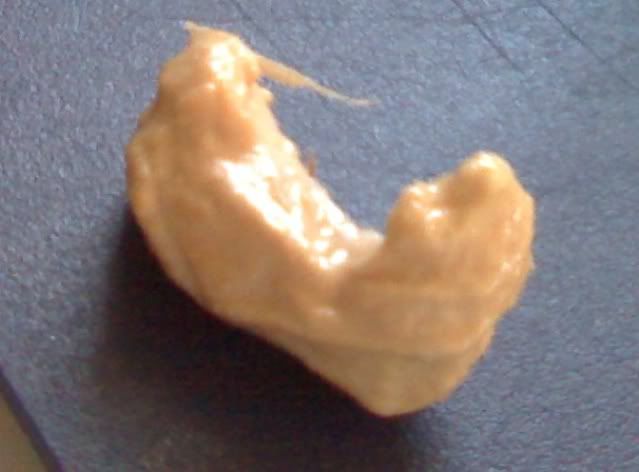
This rubbery thing was in the nesting box yesterday, along with the 3 brown eggs.
It was cold and clammy.
I left it on the counter for G-man to see. Then, in the spirit of scientific curiousity, I did something I now regret.
I cut it open.
Inside it was spongy, had a sack-type thing, and reeked of a rotten egg. I gag just thinking about it.
Lessons learned:
- If the hens leave something really bizarre in the nesting box, leave it alone.
- If the hens appear sick, diagnose and treat them immediately.
Subscribe to:
Posts (Atom)